
- English
- Español
- Português
- русский
- Français
- 日本語
- Deutsch
- tiếng Việt
- Italiano
- Nederlands
- ภาษาไทย
- Polski
- 한국어
- Svenska
- magyar
- Malay
- বাংলা ভাষার
- Dansk
- Suomi
- हिन्दी
- Pilipino
- Türkçe
- Gaeilge
- العربية
- Indonesia
- Norsk
- تمل
- český
- ελληνικά
- український
- Javanese
- فارسی
- தமிழ்
- తెలుగు
- नेपाली
- Burmese
- български
- ລາວ
- Latine
- Қазақша
- Euskal
- Azərbaycan
- Slovenský jazyk
- Македонски
- Lietuvos
- Eesti Keel
- Română
- Slovenski
- मराठी
- Srpski језик
Tantalum Carbide Ceramics – A Key Material in Semiconductor and Aerospace.
Tantalum carbide (TaC) is an ultra-high temperature ceramic material. Ultra-high temperature ceramics (UHTCs) generally refer to ceramic materials with melting points exceeding 3000℃ and used in high-temperature and corrosive environments (such as oxygen atom environments) above 2000℃, such as ZrC, HfC, TaC, HfB2, ZrB2, and HfN.
Tantalum carbide has a melting point as high as 3880℃, high hardness (Mohs hardness 9–10), a relatively high thermal conductivity (22 W·m⁻¹·K⁻¹), high flexural strength (340–400 MPa), and a relatively low coefficient of thermal expansion (6.6 × 10⁻⁶ K⁻¹). It also exhibits excellent thermochemical stability and superior physical properties, and has good chemical and mechanical compatibility with graphite and C/C composites. Therefore, TaC coatings are widely used in aerospace thermal protection, single crystal growth, energy electronics, and medical devices.
|
Density (25℃) |
Melting Point |
Coefficient of Linear Expansion |
Electrical Conductivity (25℃) |
Crystal Type |
Lattice Parameter |
Mohs Hardness (25℃) |
Vickers Hardness |
|
13.9 g·mL-1 |
3880℃ |
6.3 x 10⁻⁶K-1 |
42.1 Ω/cm |
NaCl-type structure |
4.454 Å |
9~10 |
20 GPa |
Applications in semiconductor equipment
Currently, wide-bandgap semiconductors, represented by silicon carbide (SiC), are a strategic industry serving the main economic battlefield and addressing major national needs. However, SiC semiconductors are also an industry with complex processes and extremely high equipment requirements. Among these processes, SiC single-crystal preparation is the most fundamental and crucial link in the entire industrial chain.
Currently, the most commonly used method for SiC crystal growth is the Physical Vapor Transport (PVT) method. In PVT, silicon carbide powder is heated in a sealed growth chamber at temperatures above 2300°C and near-vacuum pressure through induction heating. This causes the powder to sublimate, generating a reactive gas containing different gaseous components such as Si, Si₂C, and SiC₂. This gas-solid reaction generates a SiC single-crystal reaction source. A SiC seed crystal is placed at the top of the growth chamber. Driven by the supersaturation of the gaseous components, the gaseous components transported to the seed crystal are atomically deposited on the seed crystal surface, growing into a SiC single crystal.
This process has a long growth cycle, is difficult to control, and is prone to defects such as microtubes and inclusions. Controlling defects is crucial; even minor adjustments or drifts in the furnace's thermal field can alter crystal growth or increase defects. Later stages present the challenge of achieving faster, thicker, and larger crystals, requiring not only theoretical and engineering advancements but also more sophisticated thermal field materials.
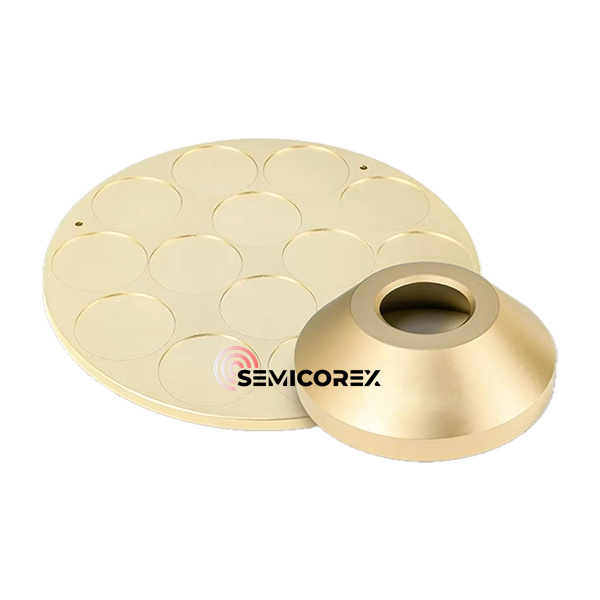
The crucible materials in the thermal field primarily include graphite and porous graphite. However, graphite is easily oxidized at high temperatures and corroded by molten metals. TaC possesses excellent thermochemical stability and superior physical properties, exhibiting good chemical and mechanical compatibility with graphite. Preparing a TaC coating on the graphite surface effectively enhances its oxidation resistance, corrosion resistance, wear resistance, and mechanical properties. It is particularly suitable for growing GaN or AlN single crystals in MOCVD equipment and SiC single crystals in PVT equipment, significantly improving the quality of the grown single crystals.
Furthermore, during the preparation of silicon carbide single crystals, after the silicon carbide single crystal reaction source is generated through a solid-gas reaction, the Si/C stoichiometric ratio varies with the thermal field distribution. It is necessary to ensure that the gas phase components are distributed and transported according to the designed thermal field and temperature gradient. Porous graphite has insufficient permeability, requiring additional pores to increase it. However, porous graphite with high permeability faces challenges such as processing, powder shedding, and etching. Porous tantalum carbide ceramics can better achieve gas phase component filtration, adjust local temperature gradients, guide material flow direction, and control leakage.
Because TaC coatings exhibit excellent acid and alkali resistance to H2, HCl, and NH3, in the silicon carbide semiconductor industry chain, TaC can also completely protect the graphite matrix material and purify the growth environment during epitaxial processes such as MOCVD.
Applications in Aerospace
As modern aircraft, such as aerospace vehicles, rockets, and missiles, develop towards high speed, high thrust, and high altitude, the requirements for the high-temperature resistance and oxidation resistance of their surface materials under extreme conditions are becoming increasingly stringent. When an aircraft enters the atmosphere, it faces extreme environments such as high heat flux density, high stagnation pressure, and high airflow scouring speed, while also facing chemical ablation due to reactions with oxygen, water vapor, and carbon dioxide. During the entry and exit of an aircraft from the atmosphere, the air around its nose cone and wings is subjected to intense compression, generating significant friction with the aircraft surface, causing it to be heated by airflow. In addition to aerodynamic heating during flight, the aircraft surface is also affected by solar radiation and environmental radiation, causing the surface temperature to continuously rise. This change can seriously affect the aircraft's service life.
TaC is a member of the ultra-high temperature resistant ceramic family. Its high melting point and excellent thermodynamic stability make TaC widely used in the hot-end parts of aircraft, such as protecting the surface coating of rocket engine nozzles.
Other Applications
TaC also has broad application prospects in cutting tools, abrasive materials, electronic materials, and catalysts. For example, adding TaC to cemented carbide can inhibit grain growth, increase hardness, and improve service life. TaC possesses good electrical conductivity and can form non-stoichiometric compounds, with conductivity varying depending on the composition. This characteristic makes TaC a promising candidate for applications in electronic materials. Regarding the catalytic dehydrogenation of TaC, studies on the catalytic performance of TiC and TaC have shown that TaC exhibits virtually no catalytic activity at lower temperatures, but its catalytic activity significantly increases above 1000℃. Research on the catalytic performance of CO has revealed that at 300℃, the catalytic products of TaC include methane, water, and small amounts of olefins.
Semicorex offers high-quality Tantalum Carbide products. If you have any inquiries or need additional details, please don't hesitate to get in touch with us.
Contact phone # +86-13567891907
Email: sales@semicorex.com