
- English
- Español
- Português
- русский
- Français
- 日本語
- Deutsch
- tiếng Việt
- Italiano
- Nederlands
- ภาษาไทย
- Polski
- 한국어
- Svenska
- magyar
- Malay
- বাংলা ভাষার
- Dansk
- Suomi
- हिन्दी
- Pilipino
- Türkçe
- Gaeilge
- العربية
- Indonesia
- Norsk
- تمل
- český
- ελληνικά
- український
- Javanese
- فارسی
- தமிழ்
- తెలుగు
- नेपाली
- Burmese
- български
- ລາວ
- Latine
- Қазақша
- Euskal
- Azərbaycan
- Slovenský jazyk
- Македонски
- Lietuvos
- Eesti Keel
- Română
- Slovenski
- मराठी
- Srpski језик
Reasons for the Gap Between Practical and Theoretical Thermal Conductivity of Silicon Nitride Ceramics
Silicon nitride (Si₃N₄) is a structural ceramic material with the intrinsic thermal conductivity around 320 W/(m·K), featuring high thermal conductivity and outstanding mechanical properties. Thanks to its superior stability at ambient temperature, Si₃N₄ has become a widely adopted ceramic substrate packaging material for the modern semiconductor industry. However, there are a notable discrepancy existing between the practical thermal conductivity of Si₃N₄ and its theoretical value. This paper explores the primary factors responsible for such divergence.
1 Lattice Oxygen
Heat conduction in Si₃N₄ is predominantly governed by phonon transmission. Lattice imperfections including vacancies, stacking faults and intergranular impurities intensify phonon scattering and degrade the thermal conductivity of silicon nitride.
Lattice oxygen serves as a decisive factor altering Si₃N₄ thermal conductivity. After oxygen atoms penetrate the Si₃N₄ lattice, silicon vacancies form, drastically shortening the phonon mean free path and reducing thermal conductivity accordingly. To boost the thermal performance of Si₃N₄, oxygen content in raw powders should be minimized to optimize sintering activity, while fine starting particle sizes are retained to block extra oxygen contamination.
Conventional sintering additives for Si₃N₄ are another major source of lattice oxygen. These additives form intergranular secondary phases with thermal conductivity generally below 1 W/(m·K) within the liquid phase, which impairs the bulk thermal conductivity of Si₃N₄. Existing research confirms that adopting rare‑earth oxide sintering additives reduces lattice oxygen content as the ionic radius of rare‑earth elements decreases. Low‑temperature sintering is preferred to cut production costs of Si₃N₄ ceramic substrates while securing full densification and desirable grain size.
Furthermore, moderate addition of reducing carbon powder suppresses secondary phase formation and improves lattice purity; excessive free carbon should be avoided to achieve elevated thermal conductivity.
2 Crystal Structure of Silicon Nitride
Silicon nitride is a strongly covalent compound with a molecular weight of 140.68. Its two prevalent polymorphs, α‑Si₃N₄ and β‑Si₃N₄, both belong to the hexagonal crystal system. Given that Si₃N₄ ceramics are commonly sintered above 1800 °C, β‑Si₃N₄ constitutes the dominant crystalline phase in commercially available Si₃N₄ components.
(1) Driving Force for β‑Si₃N₄ Grain Growth
Residual untransformed α‑Si₃N₄ remaining during the α‑to‑β phase transition imposes a pronounced negative impact on thermal conductivity. Hence, complete phase transformation from α‑Si₃N₄ to β‑Si₃N₄ is essential to facilitate nucleation and grain growth of β‑Si₃N₄ for improved thermal conductivity.
(2) Morphology of Grown β‑Si₃N₄ Grains
Thermal conductivity rises markedly with increasing β‑Si₃N₄ grain size, and extended annealing duration further enhances heat transfer capability. However, once grains grow beyond a critical dimension, additional grain coarsening brings negligible improvement to thermal performance.
3 Relative Density
Relative density exerts a prominent influence on Si₃N₄ thermal conductivity. Higher porosity leads to evident thermal conductivity degradation. In general, high‑thermal‑conductivity Si₃N₄ ceramics possess elevated bulk density and thermal diffusivity, and rare‑earth oxides facilitate the fabrication of fully dense silicon nitride. Liquid-phase sintering is mandatory to realize densification of silicon nitride ceramics and the final density of Si₃N₄varies under different sintering parameters and processing methods. For this reason, selecting appropriate sintering techniques is critical to manufacturing high-thermal-conductivity Si₃N₄ ceramics.
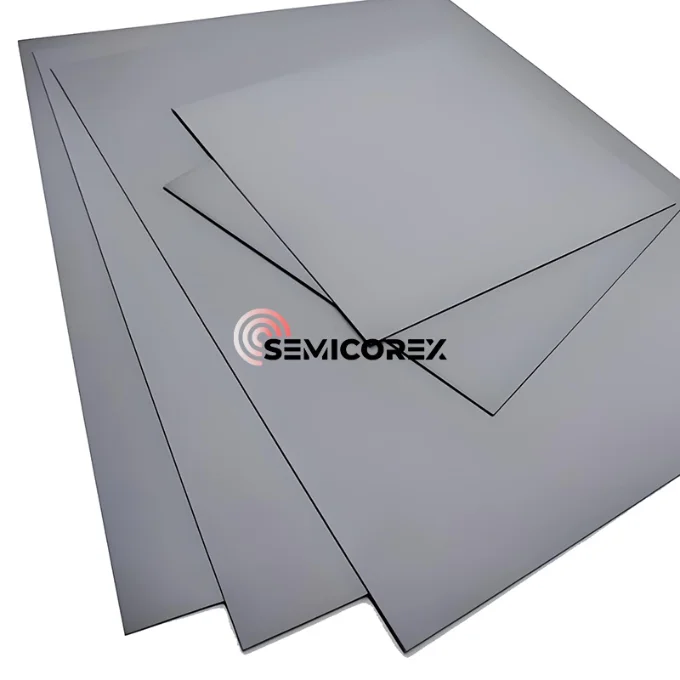
Semicorex offers high-quality silicon nitride plates for thermal oxidation processes. If you have any inquiries or need additional details, please don't hesitate to get in touch with us.
Contact phone # +86-13567891907
Email: sales@semicorex.com
Previous:Main Types of Thermal Oxidation