
- English
- Español
- Português
- русский
- Français
- 日本語
- Deutsch
- tiếng Việt
- Italiano
- Nederlands
- ภาษาไทย
- Polski
- 한국어
- Svenska
- magyar
- Malay
- বাংলা ভাষার
- Dansk
- Suomi
- हिन्दी
- Pilipino
- Türkçe
- Gaeilge
- العربية
- Indonesia
- Norsk
- تمل
- český
- ελληνικά
- український
- Javanese
- فارسی
- தமிழ்
- తెలుగు
- नेपाली
- Burmese
- български
- ລາວ
- Latine
- Қазақша
- Euskal
- Azərbaycan
- Slovenský jazyk
- Македонски
- Lietuvos
- Eesti Keel
- Română
- Slovenski
- मराठी
- Srpski језик
Development History of Ceramic Membranes
Over the past hundred years of industry development, successive material innovations for ceramic membranes are no empty marketing stunt—they are a natural progression propelled by practical industry demands. This paper briefly reviews the developmental journey of ceramic membranes across four key stages: multi-material exploration, the popularization of alumina membranes, domestic industrialization, and the technological iteration of silicon carbide membranes.
1. Military Origins: Early R&D for Special Separation Applications (1940s)
Ceramic membranes were not originally developed for water treatment, but for isotopic gas separation in the nuclear industry. Back then, the sector urgently required a carrier with stable physicochemical properties, chemical inertness, ultra-fine pore sizes, robust structural integrity, and long-term service capability under harsh operating conditions—requirements perfectly met by ceramic membranes.
At this early stage, ceramic membranes remained lab-only specialty materials, featuring crude pore size control and low separation precision, making them entirely unsuitable for industrial liquid-phase water treatment. Nevertheless, they laid the core technical foundation of stability and corrosion resistance for subsequent ceramic membrane technologies.
2. Emergence of Alumina Ceramic Membranes: Achieving the First Breakthrough in Industrial Water Treatment (1960s–1990s)
Driven by rapid global industrial expansion, surging demand for liquid clarification and material separation has emerged across the food, beverage and basic chemical sectors. Conventional plate-and-frame filters and filter papers suffered from insufficient filtration accuracy and heavy fouling, creating an industry-wide demand for reusable, cleanable inorganic filtration media. This gave rise to ceramic ultrafiltration membranes.
After engineering comparisons of multiple inorganic materials, alumina emerged as the optimal choice for civil industrialization. While not the highest-performance inorganic material available, it boasts outstanding mass-production advantages: abundant bauxite reserves and low raw material costs, mature low-temperature sintering technology, high finished product standardization, balanced physicochemical performance under normal working conditions, and controllable full-lifecycle production and maintenance expenses. Thses advantages enable alumina membranes to satisfy the fundamental industrial filtration requirements for stability and reusability, making them the first type of ceramic membrane to achieve large-scale commercial industrial application.
3. Domestic Industrialization: Independent Mass Production of Domestic Alumina Ceramic Membranes (Early 2000s)
At the start of the 21st century, domestic demand for industrial filtration surged, yet the alumina ceramic membrane market was fully monopolized by overseas suppliers. Imported membranes carried high costs and slow after-sales support, creating an urgent industry need for domestic substitution of inorganic membranes. Domestic research institutes and manufacturers collaborated on technical breakthroughs, enabling independent mass production of home-grown alumina ceramic membranes.
Localized production drastically cut the application cost of ceramic membranes for conventional water treatment, making inorganic filtration accessible to a broader range of enterprises. It also fostered a mature domestic industrial chain for ceramic membranes and accumulated critical process know-how to support subsequent R&D of high-end materials.
Nevertheless, core performance limitations persisted. Domestic alumina membranes struggled with stable long-term operation under coupled harsh conditions including high salinity, elevated temperatures, and strong acid/alkali environments prevalent in new energy and salt lake chemical industries, leaving the high-end market dominated by imported specialty membrane materials.
4. Silicon Carbide Ceramic Membranes: Custom-Built Solutions for Extreme Operating Conditions (Past Decade)
Over the last ten years, booming lithium battery, salt lake lithium extraction and semiconductor industries have generated wastewater characterized by five coupled extreme conditions: high salinity, high temperature, strong acidity/alkalinity, high organic content, and high solid particle loading.
Alumina performs reliably under standard conditions yet suffers rapid flux decline in extreme environments, failing to meet manufacturers’ demands for continuous production with minimal downtime. This created a prominent supply gap for high-performance specialty inorganic membranes.
Targeting this unmet demand for harsh-condition applications, the industry advanced high-temperature sintering technology to roll out next-generation silicon carbide ceramic membranes. Retaining all core merits of inorganic membranes—long service life, high reliability, effective interception of organic suspended solids, and repeatable cleanability—SiC membranes feature superior crystalline pore structures that accommodate all types of complex extreme water qualities, fully compensating for alumina’s operational limitations under severe working environments.
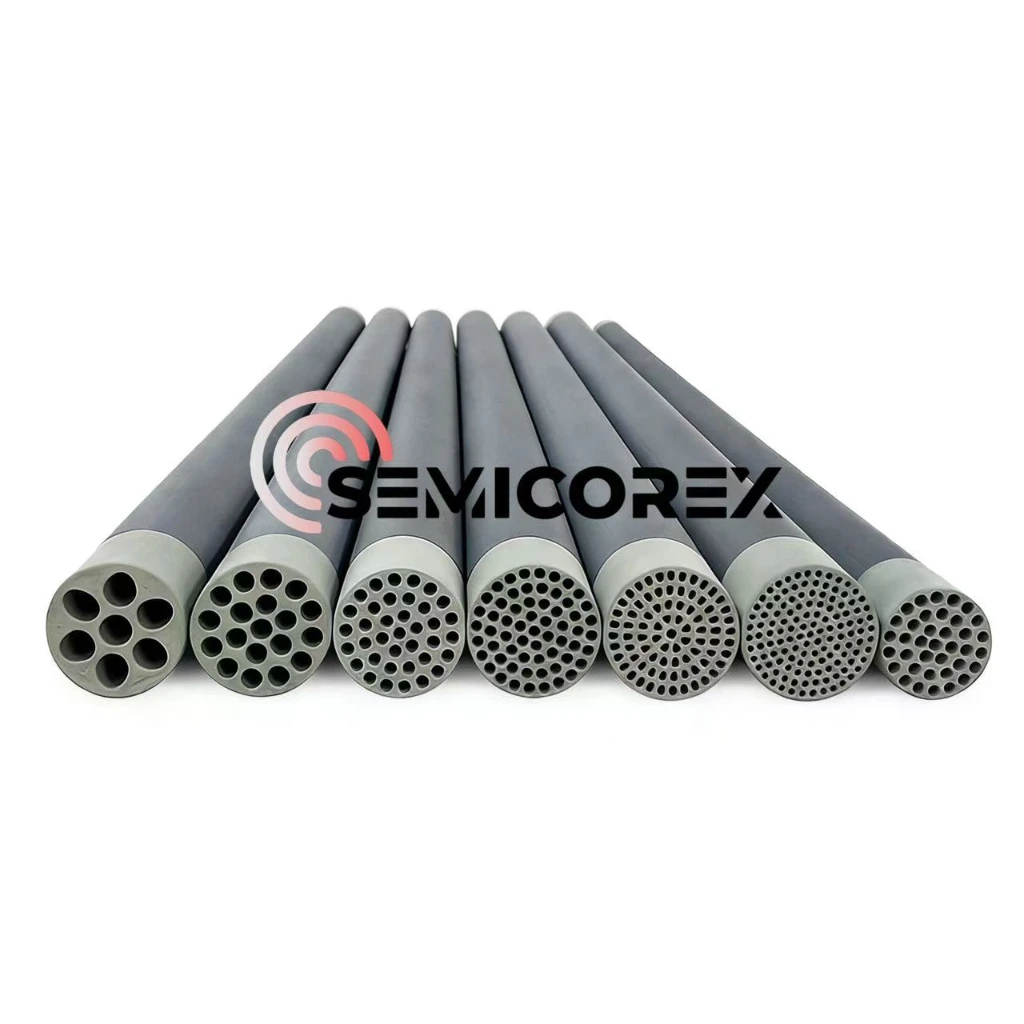
Semicorex provides high-quality silicon carbide flat sheet membranes and tubular membranes. If you have any inquiries or require further information, please feel free to contact us.
Contact phone # +86-13567891907
Email: sales@semicorex.com