
- English
- Español
- Português
- русский
- Français
- 日本語
- Deutsch
- tiếng Việt
- Italiano
- Nederlands
- ภาษาไทย
- Polski
- 한국어
- Svenska
- magyar
- Malay
- বাংলা ভাষার
- Dansk
- Suomi
- हिन्दी
- Pilipino
- Türkçe
- Gaeilge
- العربية
- Indonesia
- Norsk
- تمل
- český
- ελληνικά
- український
- Javanese
- فارسی
- தமிழ்
- తెలుగు
- नेपाली
- Burmese
- български
- ລາວ
- Latine
- Қазақша
- Euskal
- Azərbaycan
- Slovenský jazyk
- Македонски
- Lietuvos
- Eesti Keel
- Română
- Slovenski
- मराठी
- Srpski језик
Are Graphite Rigid Felt Insulation Cylinders the Ultimate High-Temperature Insulation Solution for Modern Thermal Systems
In advanced thermal processing industries, Graphite Rigid Felt Insulation Cylinders have become a critical material for achieving stable high-temperature performance, energy efficiency, and structural reliability. This article explores how Semicorex integrates high-purity graphite-based insulation technologies into demanding industrial environments such as semiconductor crystal growth, vacuum furnaces, and high-temperature sintering systems. We will break down material properties, applications, performance advantages, and selection guidelines while providing structured technical insights for engineers and procurement specialists.
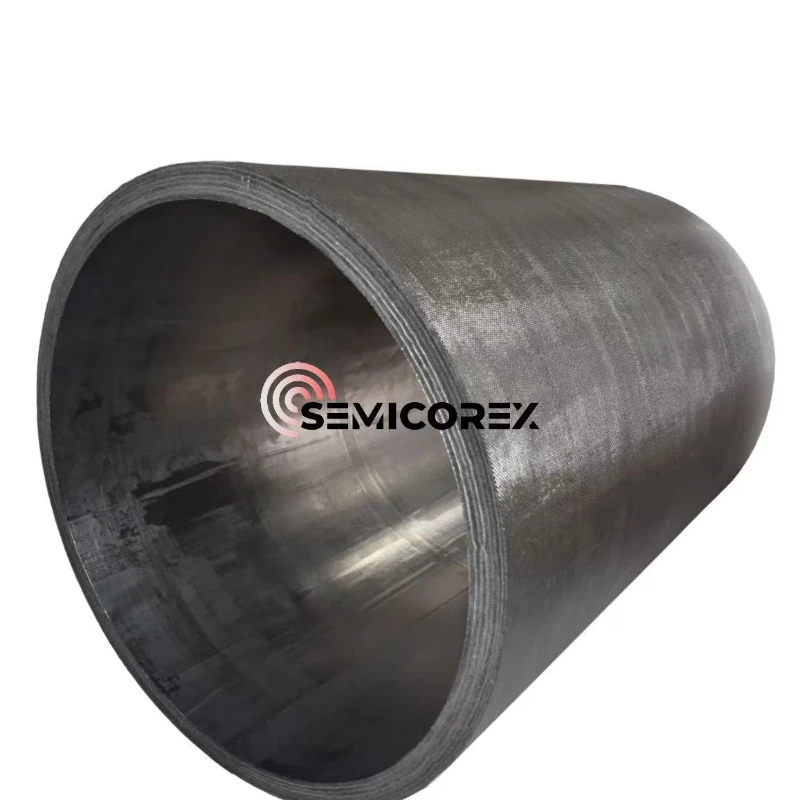
Table of Contents
- Introduction to Graphite Rigid Felt Insulation Cylinders
- Material Composition and Structural Design
- Key Performance Advantages
- Industrial Applications
- Technical Specification Comparison Table
- How to Select the Right Insulation Cylinder
- Maintenance and Service Life Considerations
- Frequently Asked Questions
- Final Thoughts
Introduction to Graphite Rigid Felt Insulation Cylinders
The demand for ultra-high temperature insulation materials has increased rapidly with the development of semiconductor manufacturing, aerospace engineering, and advanced metallurgy. In this context, Graphite Rigid Felt Insulation Cylinders provide an essential solution for maintaining thermal stability in extreme environments exceeding 2000°C. Integrated into vacuum and inert atmosphere systems, these cylindrical insulation components reduce heat loss while ensuring process consistency.
At the forefront of this technology, Semicorex delivers engineered graphite felt solutions designed for precision thermal management. These materials are widely used in furnace hot zones where uniform temperature distribution is critical.
Material Composition and Structural Design
Graphite rigid felt insulation cylinders are manufactured from high-purity carbon fibers that undergo stabilization, carbonization, and graphitization processes. The result is a lightweight yet mechanically stable insulation structure capable of withstanding extreme thermal stress.
- Base Material: High-purity polyacrylonitrile (PAN) or rayon-based carbon fiber
- Processing: High-temperature graphitization above 2500°C
- Structure: Rigid cylindrical molded felt with controlled density
- Thermal Conductivity: Extremely low to minimize heat loss
The cylindrical shape is specifically engineered for furnace hot zones, allowing seamless integration with heating elements and protective shielding layers.
Key Performance Advantages
The adoption of Graphite Rigid Felt Insulation Cylinders brings significant improvements in thermal efficiency, system longevity, and operational stability.
- Ultra-High Temperature Resistance: Stable performance above 2000°C in inert or vacuum environments
- Energy Efficiency: Reduces heat loss significantly, lowering operational costs
- Lightweight Structure: Easier installation and reduced furnace load
- Thermal Shock Resistance: Maintains integrity under rapid heating and cooling cycles
- Chemical Stability: Resistant to most corrosive gases in controlled atmospheres
These advantages make them indispensable in precision-controlled environments such as crystal growth furnaces and sintering systems.
Industrial Applications
The versatility of graphite rigid felt insulation cylinders allows them to be used across multiple high-tech industries.
- Semiconductor crystal growth furnaces
- Vacuum sintering equipment
- High-temperature graphitization furnaces
- Solar silicon production systems
- Aerospace material testing chambers
In semiconductor manufacturing, precise temperature control is essential for wafer quality and yield consistency. These insulation cylinders ensure minimal thermal fluctuation, supporting high-precision production processes.
Technical Specification Comparison Table
The following table highlights typical performance parameters of high-quality Graphite Rigid Felt Insulation Cylinders used in industrial applications:
| Parameter | Standard Range | Performance Benefit |
|---|---|---|
| Operating Temperature | 1800°C – 3000°C | Ensures stability in extreme heat environments |
| Density | 0.10 – 0.20 g/cm³ | Lightweight structure reduces furnace load |
| Thermal Conductivity | Low (≤ 0.30 W/m·K) | Minimizes energy loss |
| Purity Level | ≥ 99.9% Carbon | Reduces contamination risk |
| Service Life | Long-term usage cycles | Improves operational efficiency |
How to Select the Right Insulation Cylinder
Choosing the correct Graphite Rigid Felt Insulation Cylinders requires careful consideration of operational conditions and furnace design requirements.
- Temperature Range: Ensure compatibility with peak furnace temperature
- Atmosphere Type: Vacuum, inert gas, or reducing environments
- Dimensional Accuracy: Must match furnace chamber geometry
- Density Requirements: Balance between insulation efficiency and mechanical strength
Engineers should also consider long-term thermal cycling behavior to ensure consistent performance over repeated production cycles.
Maintenance and Service Life Considerations
Although graphite rigid felt materials are highly durable, proper handling and maintenance are essential to maximize service life.
- Avoid mechanical compression beyond design limits
- Prevent contamination from oxygen exposure at high temperatures
- Inspect regularly for structural degradation in high-cycle furnaces
- Store in dry, controlled environments before installation
With correct maintenance, these insulation cylinders can provide stable thermal performance over extended operational periods.
Frequently Asked Questions
Q1: What makes Graphite Rigid Felt Insulation Cylinders different from traditional insulation materials?
They offer significantly higher temperature resistance, lower thermal conductivity, and superior structural stability compared to ceramic or fiber-based insulation.
Q2: Can these cylinders be used in oxygen-rich environments?
They are primarily designed for vacuum and inert atmospheres. Oxygen exposure at high temperatures should be avoided.
Q3: What industries benefit the most from this material?
Semiconductor manufacturing, aerospace engineering, solar energy production, and high-temperature metallurgy industries benefit most.
Q4: How long is the typical service life?
Service life varies depending on temperature cycles and operating conditions but is generally long-lasting under proper usage.
Final Thoughts
As industries continue to push thermal boundaries, Graphite Rigid Felt Insulation Cylinders are becoming indispensable in achieving stable, energy-efficient, and high-performance furnace operations. Their unique combination of thermal resistance, structural stability, and lightweight design makes them a preferred choice for advanced engineering applications.
With advanced manufacturing expertise, Semicorex continues to provide high-quality insulation solutions tailored to the needs of modern industrial systems, ensuring both performance reliability and operational efficiency.
For customized specifications, technical consultation, or bulk procurement of Graphite Rigid Felt Insulation Cylinders, please contact us to explore how our solutions can support your high-temperature applications and improve your system performance.