
- English
- Español
- Português
- русский
- Français
- 日本語
- Deutsch
- tiếng Việt
- Italiano
- Nederlands
- ภาษาไทย
- Polski
- 한국어
- Svenska
- magyar
- Malay
- বাংলা ভাষার
- Dansk
- Suomi
- हिन्दी
- Pilipino
- Türkçe
- Gaeilge
- العربية
- Indonesia
- Norsk
- تمل
- český
- ελληνικά
- український
- Javanese
- فارسی
- தமிழ்
- తెలుగు
- नेपाली
- Burmese
- български
- ລາວ
- Latine
- Қазақша
- Euskal
- Azərbaycan
- Slovenský jazyk
- Македонски
- Lietuvos
- Eesti Keel
- Română
- Slovenski
- मराठी
- Srpski језик
What Are the Carbon-Ceramic Composites?
As the rising demand in the field of cutting-edge equipment manufacturing, carbon-ceramic composites are increasingly regarded as the promising materials for next-generation of high-performance friction systems and high-temperature structural components. So what are the carbon-ceramic composites? Fundamentally, carbon-ceramic composites are the multiphase composite structure of carbon-ceramic which are formed by silicon carbon ceramic phases into the carbon fiber-reinforced carbon matrix through chemical vapor deposition or liquid phase reaction sintering.
This composite material retains the low density, high temperature resistance, and thermal shock resistance of carbon materials, while addressing the weaknesses of pure carbon materials such as weak oxidation resistance and insufficient wear resistance. It therefore exhibits longer service life and more stable performance under extreme working conditions such as high temperature friction, high load, and high frequency operating cycling.
Advantages of carbon-ceramic composites
1.Superior mechanical performance for their high-strength, high toughness and high elastic modulus.
2.Excellent high-temperature resistance, thermal shock resistance and oxidation resistance
3.Lightweight performance, the density of carbon-ceramic composites is around 1.8-2.2g/cm³.
4.Stable frictional properties even under wet conditions, their friction coefficient is approximately 0.30-0.45.
5.Superb corrosion resistance to acids, alkalis, salts and other chemical substances.
Application of carbon-ceramic composites
For a long time, the application of carbon ceramic materials has been mainly concentrated in high-end scenarios such as aerospace and racing braking systems. Their high price, complex manufacturing processes, and limited production capacity have made it difficult for them to penetrate the larger-scale industrial market. However, with the continuous improvement of domestic high-end manufacturing and cost control capabilities, this material is moving from the laboratory to the industrial field and is widely used in transportation equipment, new energy, semiconductors and other industrial fields.
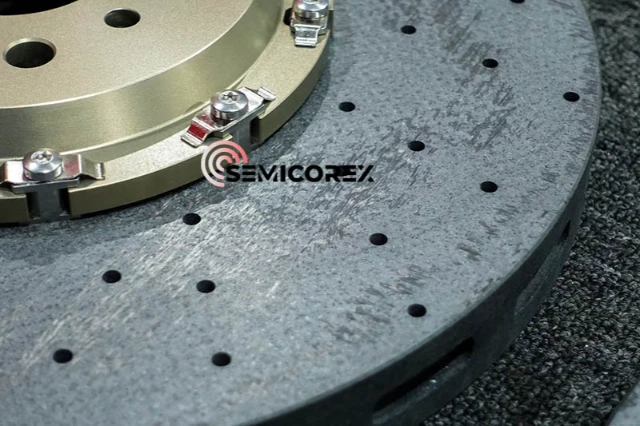
1. Compared with traditional metal brake discs, carbon ceramic materials have a significantly reduced weight at the same strength, while possessing higher heat capacity and better resistance to thermal fading. They can still maintain a stable friction coefficient under conditions of high-speed braking and frequent start-stop. This superimposed effect of lightweight and high reliability makes carbon ceramic brake discs an ideal choice for rail transit systems and the automotive market that pursue energy conservation, consumption reduction, and operational safety.
2. In the process of photovoltaic crystal pulling and heat treatment, thermal field structural components need to operate in high-temperature environments for a long time, which have extremely high requirements for high temperature resistance, thermal shock resistance, and dimensional stability. Although traditional graphite materials have a certain temperature resistance capacity, they have bottlenecks in mechanical strength and high-temperature oxidation resistance. Carbon ceramic materials, with their better performance, extend the service life of equipment, reduce replacement frequency, and have gradually become the upgrading direction for high-end thermal field equipment.
3. The semiconductor field is another typical high-barrier market. A large number of high-purity, high-temperature resistant, and low-pollution structural components and container materials are required in the links of crystal growth, epitaxy, and high-temperature heat treatment. Carbon ceramic composites have unique advantages in thermal stability and mechanical strength, and can be used for crucibles and related high-temperature components.
Previous:Mainstream Debonding Methods