
- English
- Español
- Português
- русский
- Français
- 日本語
- Deutsch
- tiếng Việt
- Italiano
- Nederlands
- ภาษาไทย
- Polski
- 한국어
- Svenska
- magyar
- Malay
- বাংলা ভাষার
- Dansk
- Suomi
- हिन्दी
- Pilipino
- Türkçe
- Gaeilge
- العربية
- Indonesia
- Norsk
- تمل
- český
- ελληνικά
- український
- Javanese
- فارسی
- தமிழ்
- తెలుగు
- नेपाली
- Burmese
- български
- ລາວ
- Latine
- Қазақша
- Euskal
- Azərbaycan
- Slovenský jazyk
- Македонски
- Lietuvos
- Eesti Keel
- Română
- Slovenski
- मराठी
- Srpski језик
Silicon Carbide Wafer Boats: the "invisible guardians of wafers" in Semiconductor
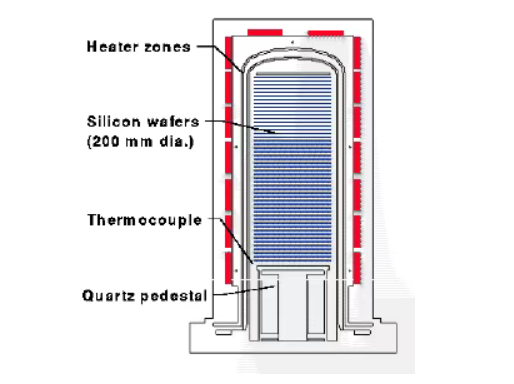
In semiconductor manufacturing, oxidation involves placing the wafer in a high-temperature environment where oxygen flows across the wafer surface to form an oxide layer. This protects the wafer from chemical impurities, prevents leakage current from entering the circuitry, prevents diffusion during ion implantation, and prevents wafer slippage during etching, forming a protective film on the wafer surface. The equipment used in this step is an oxidation furnace. The main components within the reaction chamber include a wafer boat, base, furnace liner tubes, inner furnace tubes, and heat insulation baffles. Due to the high operating temperature, the performance requirements for the components within the reaction chamber are also high.
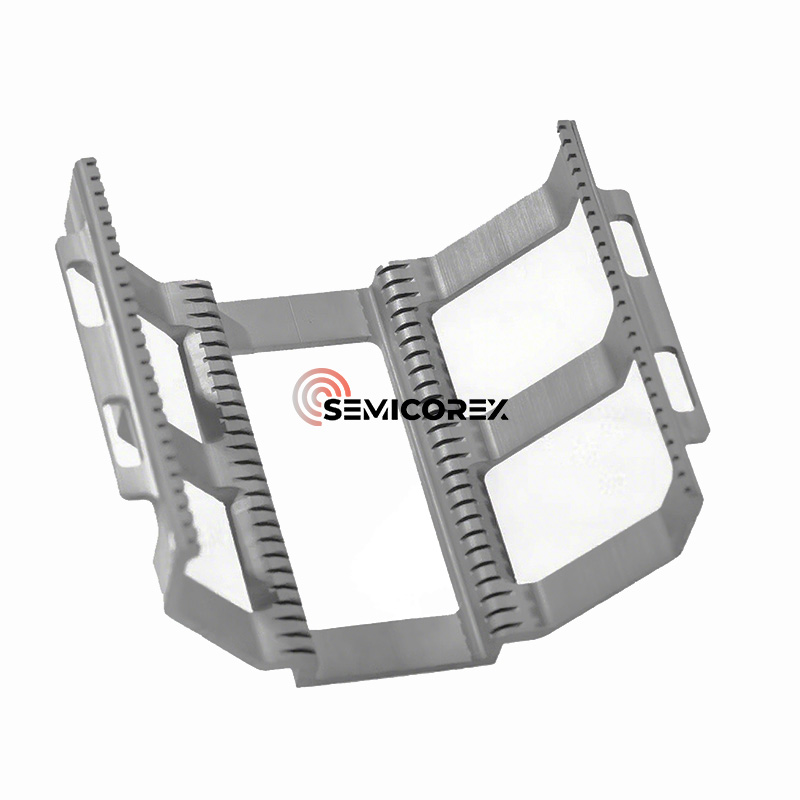
The wafer boat is used as a carrier for wafer transport and processing. It should possess advantages such as high integration, high reliability, anti-static properties, high temperature resistance, wear resistance, resistance to deformation, good stability, and long service life. Since the wafer oxidation temperature is approximately between 800℃ and 1300℃, and the requirements for the content of metallic impurities in the environment are extremely strict, key components such as the wafer boat must not only have excellent thermal, mechanical, and chemical properties, but also have extremely low metallic impurity content.
Based on the substrate, wafer boats can be classified as quartz crystal boats, silicon carbide ceramic wafer boats, etc. However, with the advancement of process nodes below 7nm and the expansion of high-temperature process windows, traditional quartz boats are gradually becoming inadequate in terms of thermal stability, particle control, and lifetime management. Silicon carbide boats (SiC boats) are gradually replacing traditional quartz solutions.
Why Silicon Carbide?
1. High-Temperature Stability
High-temperature stability is the most prominent advantage of SiC boats. They exhibit virtually no deformation or sagging even at extremely high temperatures (>1300°C), maintaining precise wafer slot positioning over extended periods.
2. Ultra-Long Lifespan
A single boat boasts high load-bearing capacity, capable of supporting dozens to hundreds of 12-inch wafers simultaneously. Compared to traditional quartz boats, SiC boats offer an average lifespan 5-10 times longer, reducing equipment changeover frequency and total cost of ownership.
3. Clean Surface and Extremely Low Contamination
High material purity and extremely low metallic impurity content prevent secondary contamination of silicon wafers. Excellent surface roughness control, with Ra below 0.1μm, suppresses particle shedding and meets the cleanliness requirements of advanced processes.
4. Suitable for Ultra-High Temperature Processes
For processes requiring temperatures above 1200°C (such as certain specialized thick-film oxidation processes, SiC device fabrication, or deep trench filling processes), SiC boats are an irreplaceable choice.
Applications of Silicon Carbide Boats
Semiconductor Manufacturing
In high-temperature processes of chip manufacturing, such as oxidation, diffusion, chemical vapor deposition (CVD), and ion implantation, silicon carbide boats are used to support silicon wafers, ensuring their flatness at high temperatures and preventing lattice misalignment or deformation caused by thermal stress, thus guaranteeing chip precision and performance.
Photovoltaic Industry
Silicon carbide ceramics possess excellent mechanical strength, thermal stability, high-temperature resistance, oxidation resistance, thermal shock resistance, and chemical corrosion resistance, making them widely used in popular fields such as metallurgy, machinery, new energy, and building materials chemicals. Their performance is also sufficient for thermal processes in photovoltaic manufacturing, such as diffusion, LPCVD (low-pressure chemical vapor deposition), and PECVD (plasma chemical vapor deposition) for TOPcon cells. Compared to traditional quartz materials, silicon carbide ceramic materials used to make boat supports, small boats, and tubular products offer higher strength, better thermal stability, and no deformation under high temperatures. Their lifespan is also more than five times that of quartz, significantly reducing operating costs and energy losses due to maintenance downtime. This results in a clear cost advantage, and the raw materials are widely available.
Third-Generation Semiconductors
In the metal-organic chemical vapor deposition (MOCVD) reaction chamber, silicon carbide boats are used to support sapphire substrates, withstanding corrosive gas environments such as ammonia (NH3), supporting the epitaxial growth of third-generation semiconductor materials such as gallium nitride (GaN), and improving the luminous efficiency and performance of LED chips. In silicon carbide single crystal growth, silicon carbide boats serve as seed crystal supports in silicon carbide single crystal growth furnaces, withstanding the high-temperature corrosive environment of molten silicon, providing stable support for the growth of silicon carbide single crystals, and promoting the preparation of high-quality silicon carbide single crystals.
Silicon Carbide Wafer Boat Development Trends
In terms of the market, according to SEMI data, the global wafer boat market size is approximately US$1.4 billion in 2025 and is projected to reach US$1.8 billion by 2028. Assuming a 20% silicon carbide penetration rate and a one-third market share in China (data from the China Semiconductor Industry Association), the Chinese market size would be US$672 million and US$864 million respectively.
Technologically, silicon carbide has a higher coefficient of thermal expansion than quartz, making it more prone to cracking in applications. Therefore, integrated molding technology is being promoted in manufacturing to reduce seams and lower the risk of particle shedding. Furthermore, optimizing the wafer boat's tooth groove design, combined with five-axis machining and wire cutting technologies, ensures the precision and smoothness of wafer handling.
Semicorex offers high-quality Silicon Carbide Wafer Boats. If you have any inquiries or need additional details, please don't hesitate to get in touch with us.
Contact phone # +86-13567891907
Email: sales@semicorex.com