
- English
- Español
- Português
- русский
- Français
- 日本語
- Deutsch
- tiếng Việt
- Italiano
- Nederlands
- ภาษาไทย
- Polski
- 한국어
- Svenska
- magyar
- Malay
- বাংলা ভাষার
- Dansk
- Suomi
- हिन्दी
- Pilipino
- Türkçe
- Gaeilge
- العربية
- Indonesia
- Norsk
- تمل
- český
- ελληνικά
- український
- Javanese
- فارسی
- தமிழ்
- తెలుగు
- नेपाली
- Burmese
- български
- ລາວ
- Latine
- Қазақша
- Euskal
- Azərbaycan
- Slovenský jazyk
- Македонски
- Lietuvos
- Eesti Keel
- Română
- Slovenski
- मराठी
- Srpski језик
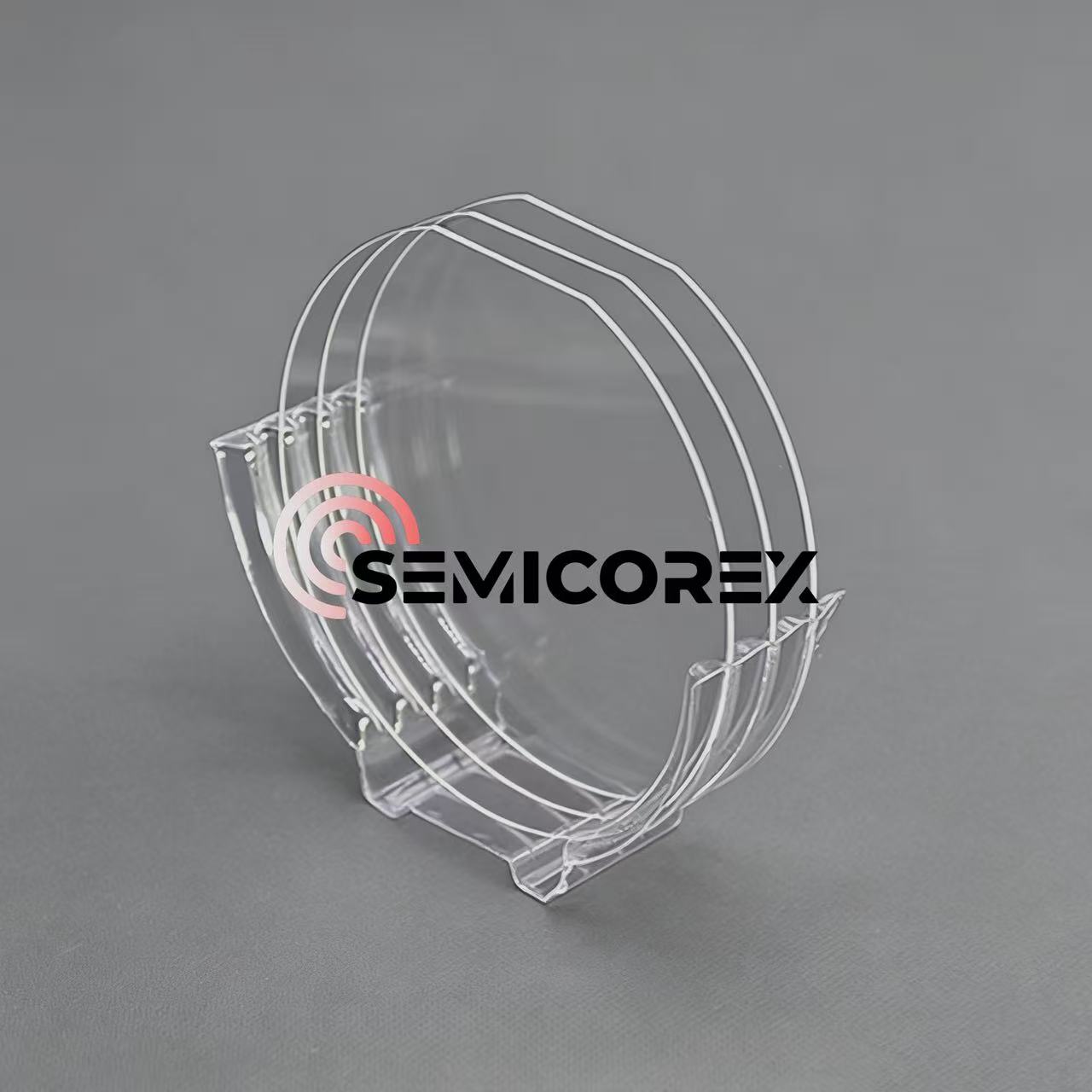
What are The Glass Wafers?
With the development of semiconductor and optical technologies, glass wafers as the new type of glass product, are gradually becoming a complement to silicon wafers, showing great potential in the field of high technology. What are the glass wafers? Glass wafers are the high-performing circular thin slices, commonly made of quartz glass, alkali-free glass, or glass-silicon composites. With excellent physical and chemical properties, they play an irreplaceable roles in cutting-edge manufacturing fields, such as semiconductor manufacturing, optics, MEMS, consumer electronics, biomedicine, and laboratory research.
The Mainstream Materials For Glass Wafers
1.Far-ultraviolet quartz glass
Far-ultraviolet quartz glass is manufactured by the chemical vapor deposition process, where gaseous silicon tetrachloride undergoes the gas-phase reaction in an oxyhydrogen flame to generate amorphous silicon dioxide, which is then deposited onto a quartz substrate for gradual growth and formation. This material contains a large amount of hydroxyl groups (950-1400 ppm), with a small total amount of metallic impurities less than 0.2 ppm. Thanks to its excellent properties like anti-radiation properties, optical uniformity, and high ultraviolet transmittance (especially in the far-ultraviolet region), far-ultraviolet quartz glass is widely applied in applications in the far-ultraviolet optics field.
However, the large-scale application of far-ultraviolet quartz glass is limited to some extent by factors such as the stripe defects that are easy to generate during the preparation process, the difficulty of molding large-sized and complex-shaped products, and the relatively high manufacturing cost.
2.Ultraviolet optical quartz glass:
Ultraviolet optical quartz glass via the flame fusion process is manufactured by melting natural crystal with an oxyhydrogen flame, followed by deposition on the surface of fused silica glass targets. Ultraviolet optical quartz glass with the hydroxyl content of 150-400 ppm offers exceptional advantages, like high ultraviolet transmittance, strong chemical stability, well thermal stability, and high mechanical strength. Benefiting from its mature manufacturing process and high cost-effectiveness, ultraviolet optical quartz glass is widely used in the electronics and semiconductor industries.
However, ultraviolet optical quartz glass has poor optical uniformity and may contain microscopic defects such as striae and micro-bubbles, which could affect optical imaging quality and laser transmission stability.
3.Infrared optical quartz glass:
Infrared optical quartz glass is produced by melting crystal powder using the vacuum electrofusion process. This material has a low hydroxyl content (<5ppm), which result in superior infrared transmittance. Thanks to its superior infrared transmittance, well chemical properties, and high mechanical strength and mature fabrication technology, infrared optical quartz glass is widely used in infrared optics applications.
However, infrared optical quartz glass contains high metallic impurities and delivers a relatively low laser damage threshold, making it unsuitable for high-energy-density laser applications and scenarios requiring extremely high far-ultraviolet light transmittance.
Previous:Sintering of Alumina Ceramics