- English
- Español
- Português
- русский
- Français
- 日本語
- Deutsch
- tiếng Việt
- Italiano
- Nederlands
- ภาษาไทย
- Polski
- 한국어
- Svenska
- magyar
- Malay
- বাংলা ভাষার
- Dansk
- Suomi
- हिन्दी
- Pilipino
- Türkçe
- Gaeilge
- العربية
- Indonesia
- Norsk
- تمل
- český
- ελληνικά
- український
- Javanese
- فارسی
- தமிழ்
- తెలుగు
- नेपाली
- Burmese
- български
- ລາວ
- Latine
- Қазақша
- Euskal
- Azərbaycan
- Slovenský jazyk
- Македонски
- Lietuvos
- Eesti Keel
- Română
- Slovenski
- मराठी
- Srpski језик

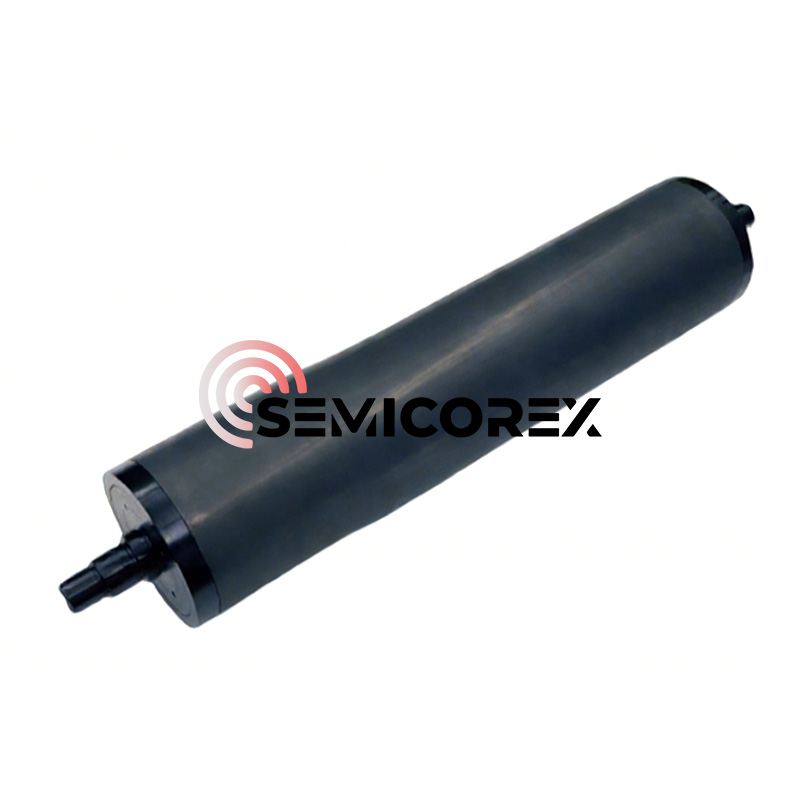
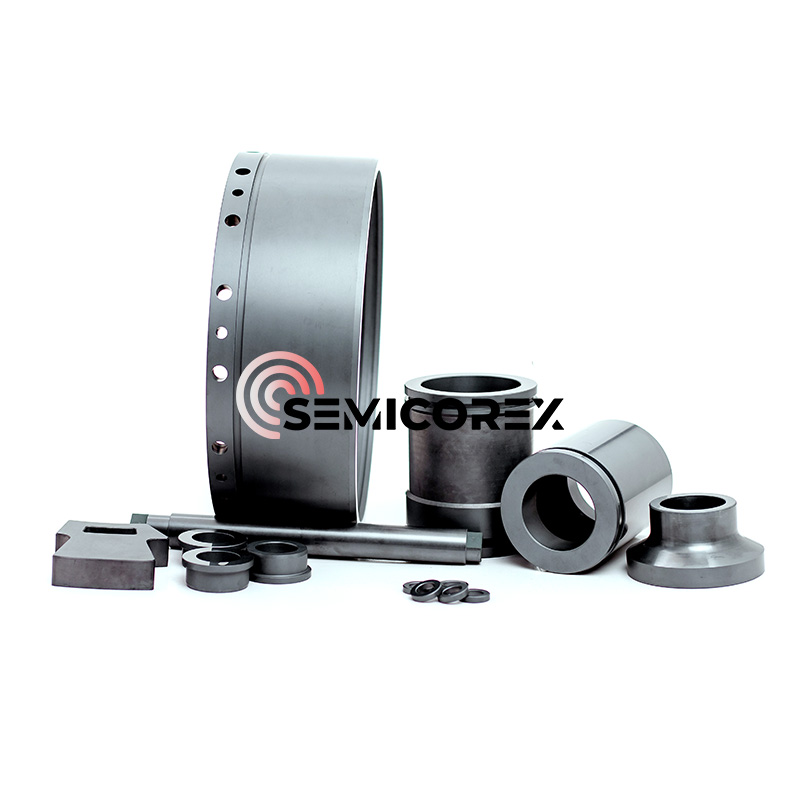
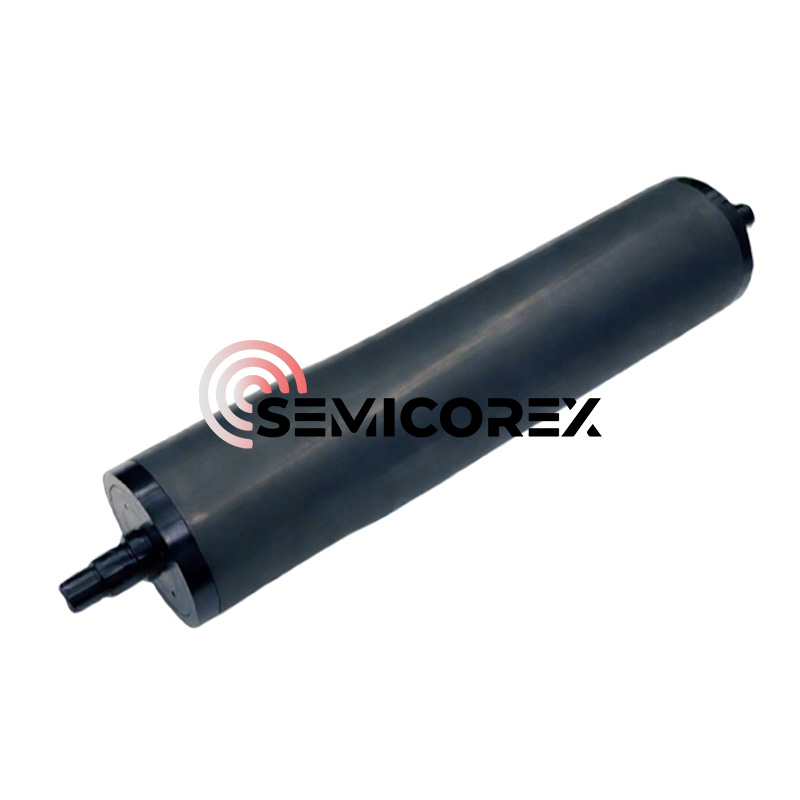
Graphite Air Bearings
Semicorex Graphite Air Bearings is a porous graphite with 15%~18% porosity used in air bearings, this is a self-lubricating bearing. Semicorex provides suitable graphite based on customer needs worldwide.*
Send Inquiry
Product Description
Semicorex Graphite Air Bearings are a high-precision aerostatic component designed to provide frictionless linear and rotary motion for ultra-precision machinery. Manufactured from a specialized grade of isostatic porous graphite, this bearing utilizes the natural permeability of the carbon microstructure to create a uniform, stiff, and stable air cushion. Unlike conventional bearings that rely on drilled orifices, the Graphite Air Bearings employs millions of sub-micron pores across its entire surface to act as a restrictor, ensuring a perfectly distributed pressure profile without gradients or pressure spikes.
Technical Specifications
Based on the Sample Test Report, Semicorex graphite exhibits the following certified properties:
|
Property |
Value |
Unit |
Significance in Air Bearing Application |
|
Material Name |
Air Floating Graphite |
N/A |
Specialized porous carbon for aerostatic lift. |
|
Average Pore Diameter |
0.5 |
µm |
Critical for "Porous Compensation." 0.5 µm is ideal for restricting airflow to generate high stiffness while filtering out particulates. |
|
Bulk Density |
1.74 |
g/cm³ |
Indicates a dense, structural graphite with controlled porosity (typically ~15-20% at this density). High density correlates with structural rigidity. |
|
Compressive Strength |
127.0 |
MPa |
Ensures the bearing can withstand high air pressure preloads and accidental impact loads without crushing or cracking. |
|
Flexural Strength |
80.7 |
MPa |
Provides resistance to bending moments, essential when the bearing is mounted on uneven surfaces or subjected to cantilevered loads. |
|
Specific Resistance |
13.02 |
µΩ·m |
Indicates the graphitization level. This electrical property correlates with thermal conductivity, aiding in heat dissipation during high-speed operation |
|
Shore Hardness |
53 |
HS |
A specialized hardness level that is softer than granite or steel guideways, ensuring the bearing sacrifices itself to protect the expensive guide surface in a crash (Soft Landing feature). |
Key Features and Benefits
Uniform Pressure Distribution: The 0.5 µm pore structure creates a "curtain" of air, eliminating the pressure ripples associated with orifice bearings and providing superior tilt stiffness.
Frictionless Motion: Zero static and dynamic friction (stiction-free) allows for infinite positioning resolution and zero wear, extending system life indefinitely.
Crash Protection (Soft Landing): The Shore 53 HS graphite surface is non-galling. In the event of air loss, the bearing settles gently onto the guide, acting as a dry lubricant and preventing catastrophic damage to the precision guideway.
High Damping: The porous graphite matrix naturally absorbs vibrations, providing a "squeeze film" damping effect that improves settling times and dynamic stability in scanning applications.
Cleanroom Compatibility: The Semicorex graphite air bearings operates without oil or grease, making it ideal for ISO Class 1 cleanroom environments common in semiconductor manufacturing.
Visual Characteristics
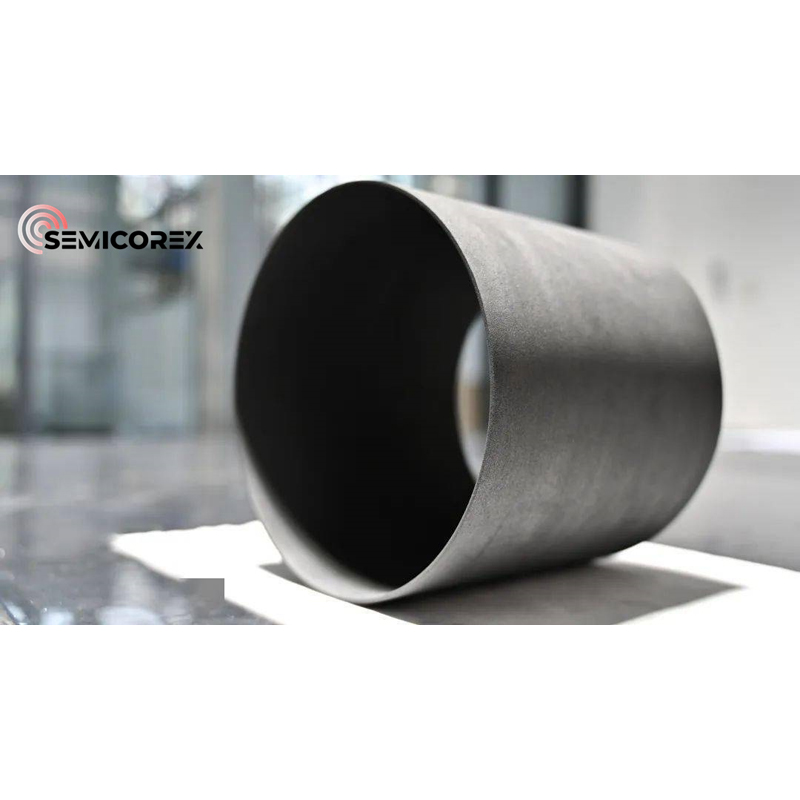
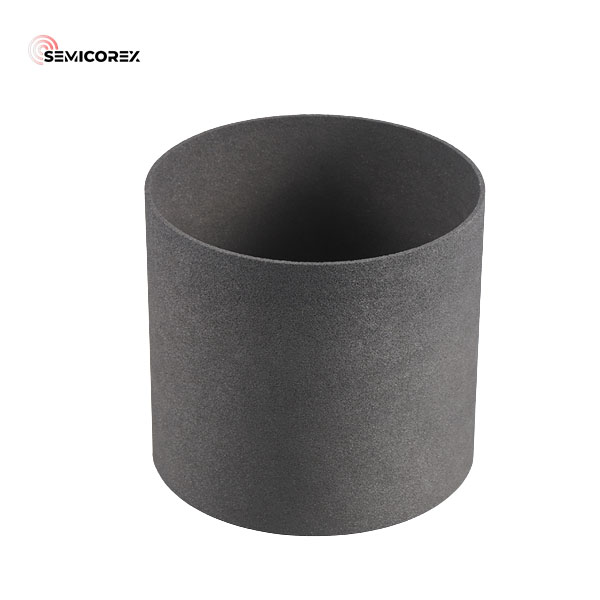
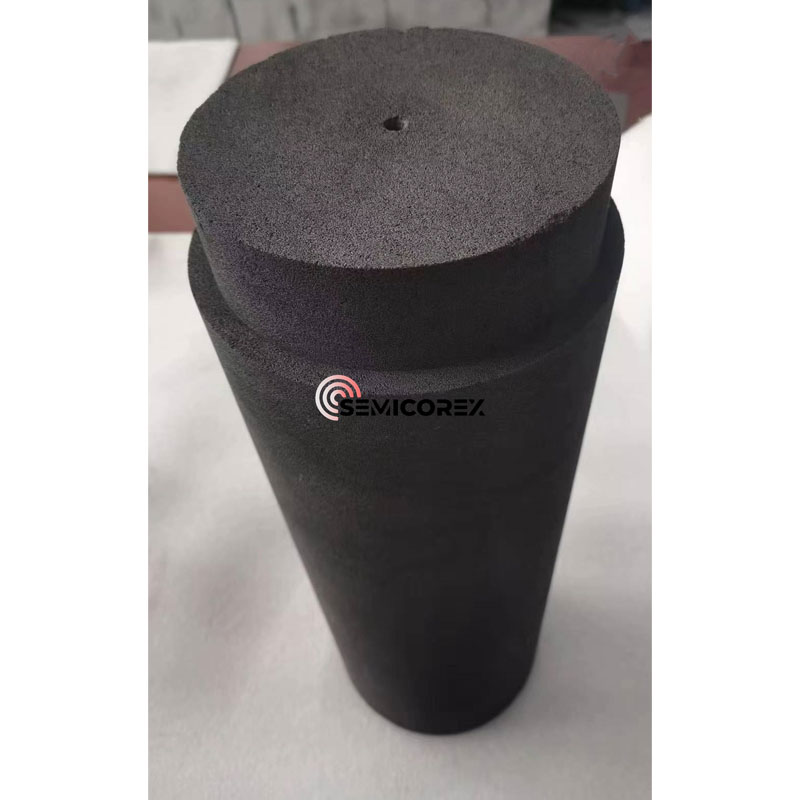
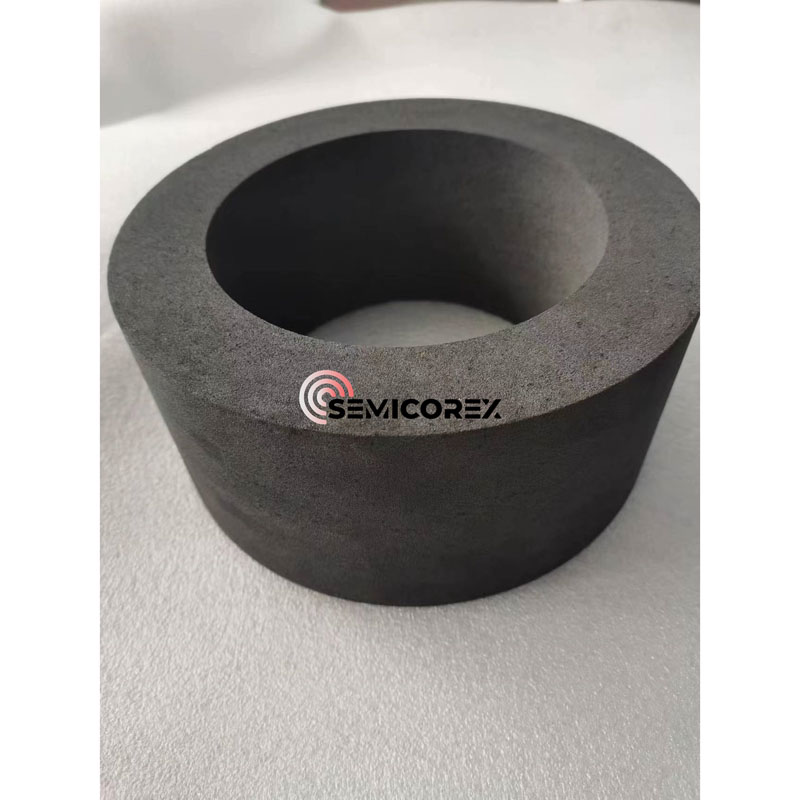
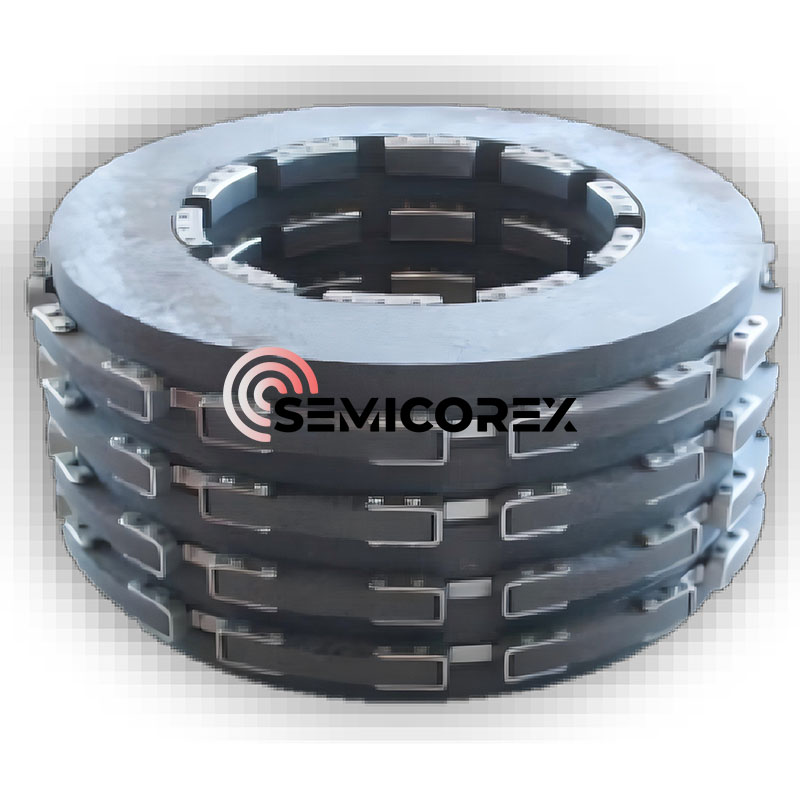
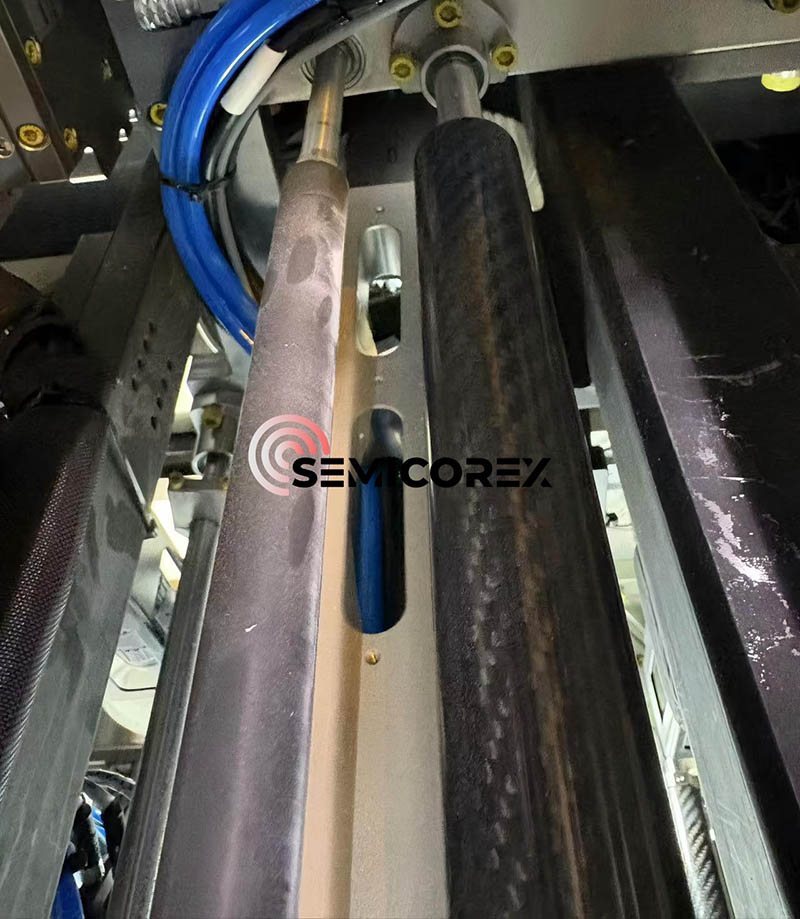
Visual inspection of Graphite Air Bearings components (referencing provided imagery) reveals:
Surface Finish: A matte, charcoal-grey finish characteristic of precision-ground graphite.
Geometry: Available in linear bar configurations with machined slots for mounting or vacuum scavenging. The porous surface appears uniform to the naked eye, concealing the microscopic pore network.
Mounting: Designed for integration with precision-machined slots or ball-stud mounting systems to ensure parallelism with the guideway.
Historical Context and Technological Evolution
The Limits of Contact Bearings
For decades, the standard for linear motion was set by recirculating ball bearings and roller slides. While robust, these systems suffer from inherent limitations defined by Hertzian contact stress. The physical contact between the rolling elements and the race generates friction, heat, and wear particles. In ultra-precision applications, the "noise" generated by the balls recirculating creates velocity ripples that are unacceptable for nanometer-level metrology. Furthermore, the need for lubrication introduces contaminants and maintenance requirements that are incompatible with modern cleanroom standards.
The Aerostatic Revolution
The transition to air bearings marked a fundamental shift in machine design. By separating surfaces with a film of air, engineers eliminated mechanical contact. Early air bearings utilized Orifice Compensation. In this design, compressed air is fed through a few precision-drilled holes (orifices) and distributed via grooves.
Limitations of Orifice Design:
Pressure Gradients: The pressure drops significantly as air moves away from the orifice/groove, reducing load capacity efficiency.
Pneumatic Hammer: The volume of air trapped in the grooves can act as a capacitor, leading to self-excited vibration or "hammering."
Clogging: A single dust particle can block an orifice, causing immediate bearing failure.
Catastrophic Crashes: Orifice bearings are typically made of hard metal (aluminum, stainless steel). If the air supply fails, the metal-on-metal or metal-on-granite contact results in severe scoring and galling.
The Advent of Porous Media Technology
Porous media air bearings, such as those utilizing the porous graphite, solved these problems by using the bearing material itself as the restrictor.
History: Developed in the mid-20th century but perfected for commercial use in the 1980s and 90s, porous carbon technology utilized the sintering process to create a material with millions of microscopic, tortuous pathways.
The Breakthrough: The key was controlling the manufacturing process to ensure isotropic permeability. The Graphite Air Bearings' specification of 0.5 µm average pore diameter represents a mature iteration of this technology, optimizing the flow restriction to maximize stiffness while minimizing air consumption. This evolution transformed air bearings from delicate lab instruments into robust industrial components capable of operating in harsh machining environments.
Material Science: Deep Dive into porous graphite for air bearing
Isostatic Graphite Manufacturing
The Graphite Air Bearings are identified as an isostatic graphite. This manufacturing process is distinct from extruded or molded graphite.
Raw Material: High-purity petroleum coke is micronized into particles (related to the fine structure seen in the 0.5 µm pore spec).
Cold Isostatic Pressing (CIP): The powder is placed in a mold and subjected to ultra-high pressure from all directions (fluid pressure). This ensures that the density (1.74 g/cm³) is uniform throughout the billet. This isotropy is crucial because it ensures that air flows through the bearing at the same rate in all directions, preventing "tilting" or uneven lift.
Graphitization: The billet is heated to ~3000°C. This aligns the crystalline structure, converting carbon to graphite. This process imparts the Specific Resistance of 13.02 µΩ·m, which is a key indicator of the degree of graphitization and thermal stability.
Microstructural Analysis
Pore Size (0.5 µm): This is a "Goldilocks" dimension.
If pores are too large (> 1.0 µm): Air consumption becomes excessive, and the bearing loses stiffness (too leaky).
If pores are too small (< 0.1 µm): The bearing requires impractical input pressures to generate lift, and response time becomes sluggish.
0.5 µm: Represents an optimization for standard industrial compressed air systems (80 PSI), balancing efficiency with high load capacity.
Density (1.74 g/cm³): Typical dense graphites range from 1.70 to 1.85 g/cm³. A value of 1.74 indicates a porosity of roughly 15-20%. This volume of "void space" acts as an internal reservoir, ensuring steady air supply to the face.
Mechanical Robustness
Compressive Strength (127.0 MPa): This value is significant. It means the bearing can support immense loads without structural failure. For context, typical concrete is ~30 MPa. porous graphite for air bearing is four times stronger than concrete in compression. This allows the bearing to be clamped or preloaded with high magnetic forces without cracking.
Flexural Strength (80.7 MPa): This is high for graphite. It ensures that the bearing pads do not warp or snap under the bending moments applied during acceleration or mounting misalignment.
Tribology and the "Soft Landing"
The Shore Hardness of 53 HS (Scleroscope) places it in the "medium-hard" category for graphites (softer than some extremely dense grades which can be 70-80 HS).
Tribological Benefit: In a crash, the bearing material must be sacrificial. Granite (the guideway) is much harder. A Shore 53 graphite will abrade into a fine powder upon impact, lubricating the slide and preventing the transfer of energy into scratching the granite. This self-lubricating property is the ultimate insurance policy for expensive machines.
Hot Tags: Graphite Air Bearings, China, Manufacturers, Suppliers, Factory, Customized, Bulk, Advanced, Durable
Product Tag
Related Category
Send Inquiry
Please feel free to give your inquiry in the form below. We will reply you in 24 hours.