
- English
- Español
- Português
- русский
- Français
- 日本語
- Deutsch
- tiếng Việt
- Italiano
- Nederlands
- ภาษาไทย
- Polski
- 한국어
- Svenska
- magyar
- Malay
- বাংলা ভাষার
- Dansk
- Suomi
- हिन्दी
- Pilipino
- Türkçe
- Gaeilge
- العربية
- Indonesia
- Norsk
- تمل
- český
- ελληνικά
- український
- Javanese
- فارسی
- தமிழ்
- తెలుగు
- नेपाली
- Burmese
- български
- ລາວ
- Latine
- Қазақша
- Euskal
- Azərbaycan
- Slovenský jazyk
- Македонски
- Lietuvos
- Eesti Keel
- Română
- Slovenski
- मराठी
- Srpski језик

Why Are CVD SiC Coatings a Must for MOCVD Graphite Susceptors?
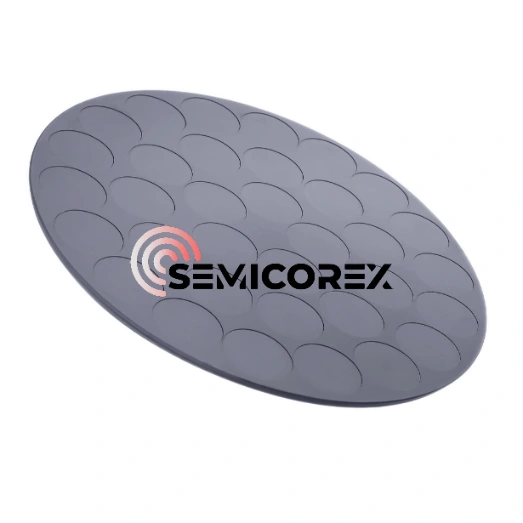
In LED chip manufacturing, MOCVD epitaxy serves as the core process that determines luminous efficiency. During production, graphite susceptors carrying sapphire or silicon substrates operate under repeated thermal cycles at temperatures close to 1,000°C within corrosive atmospheres. Accordingly, the performance of graphite susceptors directly impacts epitaxy efficiency, epitaxy uniformity and the final yield of finished devices. Depositing a CVD SiC coating on graphite susceptors has become the mainstream industry solution. This article briefly elaborates on the rationale behind this design.
What Happens When Using Uncoated Graphite Susceptors?
Graphite is excellent materials for high-temperature support, yet it has three inherent drawbacks that become drastically aggravated inside MOCVD chambers:
1. Chemical Corrosion at High Temperatures
MOCVD processes introduce ammonia, hydrogen and metal-organic precursors. When graphite comes into contact with these gases at nearly 1,000°C, hydrocarbons and even hydrogen cyanide are produced. This causes continuous corrosion of the graphite surface with gradual dimensional deviation, and the reaction byproducts contaminate the epitaxial layer.
2. Impurity Outgassing from Porous Structure
Since graphite features an inherently porous structure, residual metallic impurities, adsorbed moisture and oxygen from production are gradually released during repeated heating cycles. Each release triggers fluctuations in the background impurity concentration of the epitaxial layer, which will create unexplained defect points visible on yield curves.
3. Powdering and Deformation Under Thermal Cycling
MOCVD susceptors undergo multiple heating and cooling cycles daily. Bare graphite suffers reduced bonding force between surface particles under repeated thermal shock, resulting in powder shedding. Carbon particles falling onto epitaxial wafers lead to fatal particulate contamination.
In short, uncoated graphite susceptors act as unpredictable "impurity bombs" that continuously release contaminants inside MOCVD chambers.
What Advantages DO the CVD SiC Coating Provide?
As semiconductor manufacturing processes advance to nanometer and even atomic-scale nodes, trace surface contaminants including particulate pollutants and metallic ionic impurities will degrade or even render final semiconductor devices completely non-functional. This imposes far stricter performance requirements on graphite susceptors used in epitaxial processes. Relying on the advanced chemical vapor deposition technology, a uniformly dense SiC coating deposited on graphite susceptors. This coating acts as a robust protective ceramic armor and delivers the following key advantages:
1. Reliable Physical Protection
The SiC coating fully isolates the graphite base from process atmospheres, preventing ammonia and hydrogen from contacting the base graphite and suppressing chemical etching. Meanwhile, impurities trapped inside the graphite matrix are sealed beneath the coating and cannot leach into the chamber.
2. Ultra-High Cleanliness
The purity CVD SiC coatings achieve ppb-level purity (9N grade, above 99.999995%), vastly outperforming most graphite materials. This means that the contamination of the wafer by the CVD SiC coated graphite susceptor surface is reduced to an almost negligible level.
3. Superior Thermal Shock Resistance
MOCVD susceptors tend to sustain damage from rapid temperature fluctuations. Through process adjustments, CVD SiC coatings can firmly bond with graphite bases and adapt to the thermal expansion coefficient of graphite, effectively reducing the risk of cracking caused by extreme temperature changes.
4. Remarkable Oxidation Resistance
During oxygen-containing environments below 1600°C, an ultra-thin protective SiO₂ film naturally develops on the coating surface of CVD SiC coated graphite susceptors. This CVD SiC coating can prevent further oxidation to erode the internal graphite susceptors, acting as a last resort even in dire circumstances like an unplanned air intake during the process.