
- English
- Español
- Português
- русский
- Français
- 日本語
- Deutsch
- tiếng Việt
- Italiano
- Nederlands
- ภาษาไทย
- Polski
- 한국어
- Svenska
- magyar
- Malay
- বাংলা ভাষার
- Dansk
- Suomi
- हिन्दी
- Pilipino
- Türkçe
- Gaeilge
- العربية
- Indonesia
- Norsk
- تمل
- český
- ελληνικά
- український
- Javanese
- فارسی
- தமிழ்
- తెలుగు
- नेपाली
- Burmese
- български
- ລາວ
- Latine
- Қазақша
- Euskal
- Azərbaycan
- Slovenský jazyk
- Македонски
- Lietuvos
- Eesti Keel
- Română
- Slovenski
- मराठी
- Srpski језик

Brief Introduction to High-Resistivity Silicon Wafers
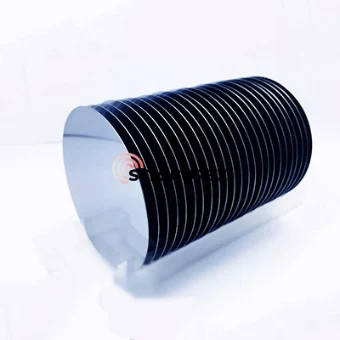
High-resistivity silicon wafers (HR-Si), as its name suggests, is a monocrystalline silicon material with extremely high resistivity. In the advanced semiconductor manufacturing field, high-frequency loss has become a major challenge in high-end chip design. Thanks to its ultra-high resistivity, the high-resistivity silicon wafer serves as the ideal solutions to suppress substrate loss and eliminate parasitic crosstalk.
Standard silicon wafers adopted by conventional logic chips (such as CPUs and GPUs) are doped with a certain concentration of impurities to facilitate electrical conduction and transistor formation, with a typical resistivity of 1–50 Ω·cm or even lower. Differently, the high-resistivity silicon wafer features a resistivity of over 1000 Ω·cm and exhibit a nearly intrinsic state with extremely low doping concentration.
Why Is the High-Resistivity Silicon Wafer Required?
With the continuous increase in communication frequencies, standard silicon substrates have severe physical limitations. The high-resistivity silicon wafers are ideal solutions to address the key issues of high-frequency signal transmission on silicon substrates.
1.Reduced Substrate Loss
In high-frequency operating conditions, electromagnetic waves will penetrate the insulating layer and then enter silicon substrates. Standard silicon substrates with low resistivity may generate eddy currents that convert high-frequency RF signal energy into thermal energy, thus causing severe energy loss. In contrast, high-resistivity silicon is nearly non-conductive, which can effectively suppress eddy currents and preserve signal energy.
2. Minimized Parasitic Capacitance and Crosstalk
The multiple RF components on chips like inductors and switches tend to form parasitic capacitive coupling through the conductive substrate, which may cause mutual signal interference. However, a high-resistivity silicon substrate can block this "conductive path" and greatly enhance the isolation level among components.
3. Improved Quality Factor (Q Factor) of Passive Devices
The high-resistivity silicon wafer can significantly improve the Q factor of on-chip inductors and effectively lower signal noise and power consumption in radio frequency circuit applications.
Major Application Scenarios of High-Resistivity Silicon Wafers
1. Radio frequency and microwave fields
2. Substrate applications for RF MEMS switches, filters, and phase shifters
3. Applications of silicon-based antenna integration and millimeter-wave devices (5G front-end modules)
4. Silicon photonic waveguide applications
5. TSV interposers manufacturing