- English
- Español
- Português
- русский
- Français
- 日本語
- Deutsch
- tiếng Việt
- Italiano
- Nederlands
- ภาษาไทย
- Polski
- 한국어
- Svenska
- magyar
- Malay
- বাংলা ভাষার
- Dansk
- Suomi
- हिन्दी
- Pilipino
- Türkçe
- Gaeilge
- العربية
- Indonesia
- Norsk
- تمل
- český
- ελληνικά
- український
- Javanese
- فارسی
- தமிழ்
- తెలుగు
- नेपाली
- Burmese
- български
- ລາວ
- Latine
- Қазақша
- Euskal
- Azərbaycan
- Slovenský jazyk
- Македонски
- Lietuvos
- Eesti Keel
- Română
- Slovenski
- मराठी
- Srpski језик
What is the Silicon Carbide?
As the name suggests, silicon carbide is an important third-generation semiconductor material, which is a compound composed of Si and C. This combination of these two elements results in a robust tetrahedral structure, giving it numerous advantages and broad application prospects, especially in the fields of power electronics and new energy.
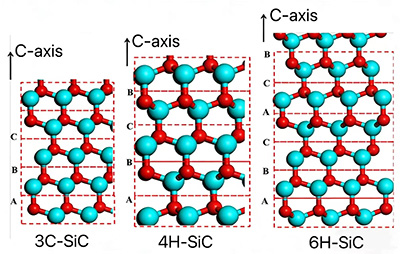
Of course, SiC material is not composed of a single tetrahedron of one Si atom and one C atom, but of countless Si and C atoms. A large number of Si and C atoms form undulating double atomic layers (one layer of C atoms and one layer of Si atoms), and numerous double atomic layers stack to form SiC crystals. Due to periodic changes occurring during the stacking process of Si-C double atomic layers, there are currently more than 200 different crystal structures with distinct arrangements. Currently, the most common crystal forms in practical applications are 3C-SiC, 4H-SiC, and 6H-SiC.
The advantages of silicon carbide crystals:
(1) Mechanical Properties
silicon carbide crystals have extremely high hardness and good wear resistance, being the second hardest crystal found so far, only after diamond. Due to its excellent mechanical properties, powdered silicon carbide is often used in the cutting or polishing industry, and wear-resistant coatings on some workpieces also use silicon carbide coatings—for example, the wear-resistant coating on the deck of the Shandong warship is made of silicon carbide.
(2) Thermal Properties
The thermal conductivity of silicon carbide is 3 times that of traditional semiconductor Si and 8 times that of GaAs. Devices made of silicon carbide can dissipate heat generated quickly, so silicon carbide devices have relatively loose requirements on heat dissipation conditions and are more suitable for manufacturing high-power devices. Silicon carbide also has stable thermodynamic properties: under normal pressure, it decomposes directly into Si and C vapor at high temperatures without melting.
(3) Chemical Properties
Silicon carbide has stable chemical properties and excellent corrosion resistance. It does not react with any known acid at room temperature. When silicon carbide is placed in the air for a long time, a dense SiO2 thin layer will slowly form on its surface, preventing further oxidation reactions.
(4) Electrical Properties
As a representative material of wide-bandgap semiconductors, the bandgap widths of 6H-SiC and 4H-SiC are 3.0 eV and 3.2 eV respectively, which are 3 times that of Si and 2 times that of GaAs. Semiconductor devices made of silicon carbide have smaller leakage current and larger breakdown electric field, so silicon carbide is considered an ideal material for high-power devices. The saturated electron mobility of silicon carbide is also 2 times higher than that of Si, giving it obvious advantages in manufacturing high-frequency devices.
(5) Optical Properties
Due to its wide bandgap, undoped silicon carbide crystals are colorless and transparent. Doped silicon carbide crystals show different colors due to differences in their properties. For example, after doping with N, 6H-SiC appears green, 4H-SiC appears brown, and 15R-SiC appears yellow; doping with Al makes 4H-SiC appear blue. Observing the color to determine the polytype is an intuitive method to distinguish silicon carbide polytypes.
Semicorex offers silicon carbide substrates in various sizes and grades. Please feel free to contact us with any questions or for further details.
Tel: +86-13567891907
Email: sales@semicorex.com