
- English
- Español
- Português
- русский
- Français
- 日本語
- Deutsch
- tiếng Việt
- Italiano
- Nederlands
- ภาษาไทย
- Polski
- 한국어
- Svenska
- magyar
- Malay
- বাংলা ভাষার
- Dansk
- Suomi
- हिन्दी
- Pilipino
- Türkçe
- Gaeilge
- العربية
- Indonesia
- Norsk
- تمل
- český
- ελληνικά
- український
- Javanese
- فارسی
- தமிழ்
- తెలుగు
- नेपाली
- Burmese
- български
- ລາວ
- Latine
- Қазақша
- Euskal
- Azərbaycan
- Slovenský jazyk
- Македонски
- Lietuvos
- Eesti Keel
- Română
- Slovenski
- मराठी
- Srpski језик
SiC Ceramic Mechanical Seals
Dry gas seals are a new type of non-contact seal developed through fundamental improvements to mechanical seals, based on gas dynamic pressure bearings. Dry gas seals offer high limiting speeds, excellent sealing performance, long service life, eliminate the need for a sealing oil system, consume less power, are easy to operate, and have low operating and maintenance costs, making them widely used in the petroleum industry. Due to the high surface speed of the seal faces, the combined effects of centrifugal force and media pressure can cause significant mechanical and thermal deformation of the rotating and stationary rings under pressure and during operation. Since the gas film thickness between the rotating and stationary rings is only a few micrometers, even minor deformation can seriously affect the sealing effect and reliability. Therefore, dry gas seals place high demands on the friction pair sealing materials.
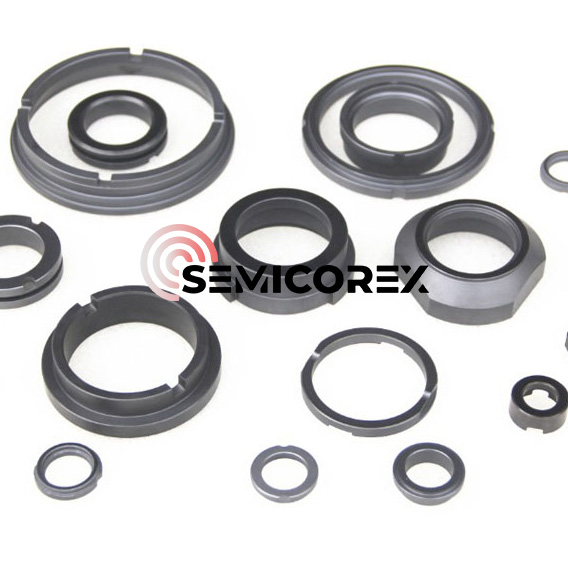
To ensure the normal operation of the sealing rings in mechanical sealing devices, and considering factors such as friction reduction, corrosion resistance, and prevention of seizing, the sealing rings are often made of a pair of rings with different hardnesses, typically a hard ring and a soft ring. The hard ring is usually the rotating ring, so the hard ring material should possess sufficient strength and rigidity, good friction properties, good thermal conductivity and heat resistance, and good corrosion resistance.
The high hardness and low friction coefficient of silicon carbide give it excellent wear resistance, making it particularly suitable for various sliding friction and wear conditions. Silicon carbide has very high high-temperature strength; its bending strength at 1400°C is the same as at room temperature. It can be processed into sealing rings of various shapes, sizes, and high surface finish, offering good airtightness and long service life. Therefore, silicon carbide can be used in mechanical seals under high-temperature conditions.
Silicon carbide has good chemical stability and can withstand various highly corrosive acidic and alkaline media, making it suitable for mechanical seals in corrosive media. Corrosive wear is a major form of failure for friction pair materials. Hot-pressed sintered silicon carbide forms a protective silicon dioxide film on its surface in an oxidizing atmosphere, maintaining good chemical stability and strong corrosion resistance even at 900°C.
SiC ceramic is a high-performance special ceramic material with high strength, high hardness, high temperature resistance, chemical corrosion resistance, wear resistance, and thermal shock resistance. However, when SiC ceramic seals undergo frictional contact, their high hardness characteristics cause adhesion between the two working surfaces during dry gas seal start-up and shut-down. This increases the friction coefficient and raises the end-face temperature, leading to localized heating and thermal shock. The friction pair seizes and adheres, exacerbating end-face wear and significantly shortening the service life of the seal, resulting in premature failure. Therefore, modification of SiC ceramics is necessary. Research shows that uniformly distributed nanoparticles, whiskers, and fibers in the SiC ceramic matrix can inhibit the propagation of internal cracks in SiC ceramics through crack bridging, crack deflection, crack pinning, and pull-out toughening, thereby improving its mechanical properties.
Currently, the main sintering methods for SiC ceramics are reaction sintering and pressureless sintering. Reaction-sintered SiC ceramics have poor overall performance and cannot meet the requirements of dry gas seals, while pressureless-sintered silicon carbide exhibits excellent hardness, apparent porosity, flexural strength, and compressive strength, making it an ideal material for dry gas seal friction pairs. Pressureless sintering is further divided into solid-phase sintering and liquid-phase sintering. Liquid-phase sintering utilizes multi-component low-eutectic oxides that form a eutectic liquid phase at high temperatures as sintering aids. This changes the mass transfer mechanism of the ceramic powder from diffusion to viscous flow, which, compared to solid-phase sintering, can significantly reduce the energy required for ceramic densification, aligning with national initiatives for energy conservation and emission reduction.
Semicorex offers customized SiC mechanical seals . If you have any inquiries or need additional details, please don't hesitate to get in touch with us.
Contact phone # +86-13567891907
Email: sales@semicorex.com
Previous:What is the particle defects?