
- English
- Español
- Português
- русский
- Français
- 日本語
- Deutsch
- tiếng Việt
- Italiano
- Nederlands
- ภาษาไทย
- Polski
- 한국어
- Svenska
- magyar
- Malay
- বাংলা ভাষার
- Dansk
- Suomi
- हिन्दी
- Pilipino
- Türkçe
- Gaeilge
- العربية
- Indonesia
- Norsk
- تمل
- český
- ελληνικά
- український
- Javanese
- فارسی
- தமிழ்
- తెలుగు
- नेपाली
- Burmese
- български
- ລາວ
- Latine
- Қазақша
- Euskal
- Azərbaycan
- Slovenský jazyk
- Македонски
- Lietuvos
- Eesti Keel
- Română
- Slovenski
- मराठी
- Srpski језик
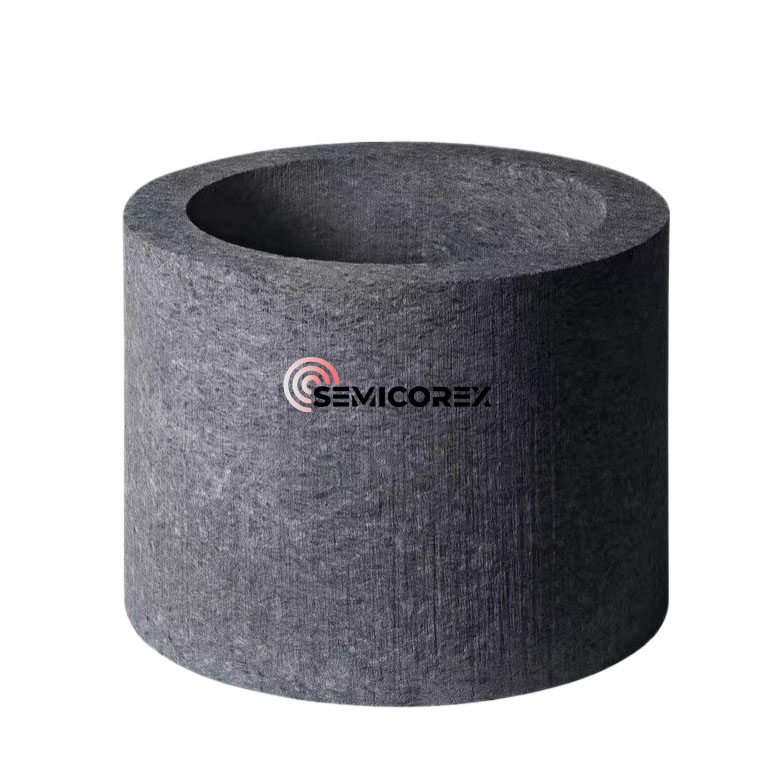
Carbon Fiber Thermal Insulation Material
The combination of soft felt and rigid/rigidized felt essentially involves balancing three things: heat conduction (solid/gas phase), radiative heat transfer, and structure and assembly. Focusing on only one indicator (such as the lowest high-temperature thermal conductivity) will usually lead to problems in areas such as strength, dimensional stability, heat leakage at seams, and fiber shedding/contamination.
1. Functional Positioning of Two Types of Felt
Soft felt is more like a "thermal resistance body + adapting layer."
Advantages: Flexible, compressible, able to conform to irregular surfaces, strong seam-filling ability, and high assembly tolerance. Risks: Moderate dimensional stability, erosion/wear resistance, and puncture resistance; thermal conductivity changes significantly after compression (compaction increases solid-phase contact, leading to an increase in equivalent thermal conductivity).
Hard felt is more like a "structural/thermal surface protection + shape-retaining layer."
A common approach is to impregnate soft felt with resin and then carbonize it to create a "laminated/hardened felt," which is machinable and has higher strength. Some carbon felt companies explicitly state that their products are "made from soft felt impregnated with resin" and provide typical parameters such as high-temperature thermal conductivity and density. Risks: Hardening/densification often increases solid-phase thermal conductivity; simultaneously, the hard layer is more "brittle," making it more prone to cracking near seams or fixing points under thermal cycling/assembly stress (requires structural detail analysis).
2. The core of the composite design: Prioritizing "radiation" in density arrangement (especially at the high-temperature end).
The framework of equating radiation to (k_rad) and explaining the role of microstructure using extinction coefficient/optical thickness is very suitable for guiding soft/hard felt layering: the radiation term at the high-temperature end increases with (T3), while (k_rad) is approximately proportional to (1/βR) in the Rosseland diffusion approximation; the larger the optical thickness (τ=βL), the more "opaque" the material, and the more difficult it is for radiation to penetrate.
Conclusion (most useful for layering): To suppress radiation, prioritize placing layers with higher extinction/higher optical thickness near the hot surface; to suppress solid-phase thermal conductivity, prioritize controlling the bulk thickness. This is the physical starting point of "density gradient/hierarchical structure".
3. Three Most Commonly Used and Less Prone to Problem Structural Combinations
A: Thin Hard Felt on Hot Surface + Thick Soft Felt on Back ("Hot Surface Skin + Insulating Body")
When to Use: When the hot surface is subject to abrasion/erosion/removal friction, or when you need the hot surface to be machined (grooving, positioning, air/flow guiding structures).
Beware of fiber shedding, airflow lifting, or deformation caused by localized thermal shock on the soft felt hot surface.
Why it's Effective: The thin hard felt, close to the hot surface, can "absorb" a portion of the radiation (increasing the optical thickness of the hot end) while providing wear-resistant support; the main thickness is still borne by the soft felt, avoiding making the overall structure too dense, which would increase solid-phase thermal conductivity.
Key Points: Don't overdo the thickness of the hard felt: The thicker the hard layer, the greater the risk of solid-phase thermal conductivity/thermal bridging; the value of the hard layer lies more in "hot-end radiation shielding + mechanical skin".
Option B: Hot-surface soft felt (with optional graphite foil/paper) + outer hard felt plate ("clean hot surface + structural exoskeleton")
When to use: Typical high-temperature furnace/vacuum furnace/sintering furnace lining: The hot surface prioritizes cleanliness and temperature uniformity, while the outer surface prioritizes fixation and shape retention.
The insulation layer needs to be made into a "modular/replaceable" panel or cylinder.
Industry practice evidence: This type of furnace lining solution uses soft/hard felt plates to create rectangular or polygonal furnace cavity insulation. Publicly available information explicitly mentions adding graphite foil between layers to improve performance and connection sealing, and emphasizes achieving durable and airtight connections through connection/fixing systems.
Why this arrangement works: Soft felt adheres more easily to the hot surface, reducing gaps (gap can easily become "radiation channels" at high temperatures); graphite foil/surface layer also provides "reflection/isolation/fiber-preventing" functions; the outer hard felt supports the structure and installation (studs, clips, overlaps), reducing the risk of the soft felt being crushed or shifted.
Option C: Hierarchical density multilayer (hard → semi-hard → soft), with "radiation shielding" at the hot end and "low solid-phase thermal conductivity" at the cold end.
When to use: High temperatures (high radiation ratio), sensitive to weight/thickness; high thermal cycling and lifespan requirements, aiming to reduce stress concentration and cracking risk at single interfaces.
Why it's more stable: This makes the "high extinction at the hot end" of Option A smoother: several layers at the hot end provide higher (beta) (higher optical thickness), while the main thickness at the cold end maintains low solid-phase thermal conductivity; it also disperses the gradient of assembly compression and thermal shrinkage, reducing "stress steps" at hard/soft single interfaces.
Semicorex offers high-quality thermal insulation felt products. If you have any inquiries or need additional details, please don't hesitate to get in touch with us.
Contact phone # +86-13567891907
Email: sales@semicorex.com