
- English
- Español
- Português
- русский
- Français
- 日本語
- Deutsch
- tiếng Việt
- Italiano
- Nederlands
- ภาษาไทย
- Polski
- 한국어
- Svenska
- magyar
- Malay
- বাংলা ভাষার
- Dansk
- Suomi
- हिन्दी
- Pilipino
- Türkçe
- Gaeilge
- العربية
- Indonesia
- Norsk
- تمل
- český
- ελληνικά
- український
- Javanese
- فارسی
- தமிழ்
- తెలుగు
- नेपाली
- Burmese
- български
- ລາວ
- Latine
- Қазақша
- Euskal
- Azərbaycan
- Slovenský jazyk
- Македонски
- Lietuvos
- Eesti Keel
- Română
- Slovenski
- मराठी
- Srpski језик

Detailed Explanation of Semiconductor CVD SiC Process Technology(Part.I)
I. Overview of Chemical Vapor Deposition (CVD) Silicon Carbide (Sic) Process Technology
Before discussing the Chemical Vapor Deposition (CVD) silicon carbide (Sic) process technology, let's first review some basic knowledge about "chemical vapor deposition."
Chemical Vapor Deposition (CVD) is a commonly used technique for preparing various coatings. It involves depositing gaseous reactants onto a substrate surface under appropriate reaction conditions to form a uniform thin film or coating.
CVD silicon carbide (Sic) is a vacuum deposition process used to produce high-purity solid materials. This process is frequently used in semiconductor manufacturing to form thin films on wafer surfaces. In the CVD process for preparing silicon carbide (Sic), the substrate is exposed to one or more volatile precursors. These precursors undergo a chemical reaction on the substrate surface, depositing the desired silicon carbide (Sic) deposit. Among the many methods for preparing silicon carbide (SiC) materials, chemical vapor deposition (CVD) produces products with high uniformity and purity, and offers strong process controllability.
CVD-deposited silicon carbide (SiC) materials possess a unique combination of excellent thermal, electrical, and chemical properties, making them ideal for applications in the semiconductor industry requiring high-performance materials. CVD-deposited SiC components are widely used in etching equipment, MOCVD equipment, Si epitaxial equipment, SiC epitaxial equipment, and rapid thermal processing equipment.
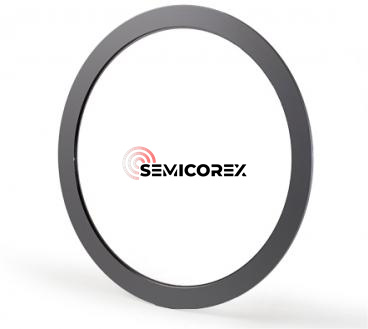
Overall, the largest segment of the CVD-deposited SiC component market is etching equipment components. Due to the low reactivity and conductivity of CVD-deposited SiC to chlorine- and fluorine-containing etching gases, it is an ideal material for components such as focusing rings in plasma etching equipment. In etching equipment, components for chemical vapor deposition (CVD) silicon carbide (SiC) include focusing rings, gas spray heads, trays, and edge rings. Taking the focusing ring as an example, it is a crucial component placed outside the wafer and in direct contact with it. By applying voltage to the ring, the plasma passing through it is focused onto the wafer, improving processing uniformity. Traditionally, focusing rings are made of silicon or quartz. With the advancement of integrated circuit miniaturization, the demand and importance of etching processes in integrated circuit manufacturing are constantly increasing. The power and energy of etching plasma are continuously improving, especially in capacitively coupled plasma etching equipment where higher plasma energy is required. Therefore, the use of focusing rings made of silicon carbide is becoming increasingly common.
In simple terms: Chemical vapor deposition (CVD) silicon carbide (SiC) refers to silicon carbide material produced through a chemical vapor deposition process. In this method, a gaseous precursor, typically containing silicon and carbon, reacts in a high-temperature reactor to deposit a silicon carbide film onto a substrate. Chemical vapor deposition (CVD) silicon carbide (SiC) is valued for its superior properties, including high thermal conductivity, chemical inertness, mechanical strength, and resistance to thermal shock and abrasion. These properties make CVD SiC ideal for demanding applications such as semiconductor manufacturing, aerospace components, armor, and high-performance coatings. The material exhibits exceptional durability and stability under extreme conditions, ensuring its effectiveness in enhancing the performance and lifespan of advanced technologies and industrial systems.
II. Basic Process of Chemical Vapor Deposition (CVD)
Chemical vapor deposition (CVD) is a process that transforms materials from a gaseous phase to a solid phase, used to form thin films or coatings on a substrate surface. The basic process of vapor deposition is as follows:
1. Substrate Preparation:
Select a suitable substrate material and perform cleaning and surface treatment to ensure the substrate surface is clean, smooth, and has good adhesion.
2. Reactive Gas Preparation:
Prepare the required reactive gases or vapors and introduce them into the deposition chamber through a gas supply system. Reactive gases can be organic compounds, organometallic precursors, inert gases, or other desired gases.
3. Deposition Reaction:
Under the set reaction conditions, the vapor deposition process begins. The reactive gases react chemically or physically with the substrate surface to form a deposit. This can be vapor-phase thermal decomposition, chemical reaction, sputtering, epitaxial growth, etc., depending on the deposition technique used.
4. Control and Monitoring:
During the deposition process, key parameters need to be controlled and monitored in real time to ensure that the obtained film has the desired properties. This includes temperature measurement, pressure control, and gas flow rate regulation to maintain the stability and consistency of reaction conditions.
5. Deposition Completion and Post-Deposition Processing
Once the predetermined deposition time or thickness is reached, the supply of reactive gas is stopped, ending the deposition process. Then, appropriate post-deposition processing is performed as needed, such as annealing, structure adjustment, and surface treatment, to improve the film's performance and quality.
It should be noted that the specific vapor deposition process can vary depending on the deposition technology used, the material type, and the application requirements. However, the basic process described above covers most of the common steps in vapor deposition.
Semicorex offers high-quality CVD SiC products. If you have any inquiries or need additional details, please don't hesitate to get in touch with us.
Contact phone # +86-13567891907
Email: sales@semicorex.com
Previous:Carbon Fiber Modification