
- English
- Español
- Português
- русский
- Français
- 日本語
- Deutsch
- tiếng Việt
- Italiano
- Nederlands
- ภาษาไทย
- Polski
- 한국어
- Svenska
- magyar
- Malay
- বাংলা ভাষার
- Dansk
- Suomi
- हिन्दी
- Pilipino
- Türkçe
- Gaeilge
- العربية
- Indonesia
- Norsk
- تمل
- český
- ελληνικά
- український
- Javanese
- فارسی
- தமிழ்
- తెలుగు
- नेपाली
- Burmese
- български
- ລາວ
- Latine
- Қазақша
- Euskal
- Azərbaycan
- Slovenský jazyk
- Македонски
- Lietuvos
- Eesti Keel
- Română
- Slovenski
- मराठी
- Srpski језик

What are First-generation, Second-generation, Third-generation, and Fourth-generation Semiconductor Materials?
2025-12-21
Semiconductor materials are the materials with electrical conductivity between conductors and insulators at room temperature, which are widely used in fields like integrated circuits, communications, energy and optoelectronics. With development of technology, semiconductor materials have evolved from the first generation to the fourth generation.
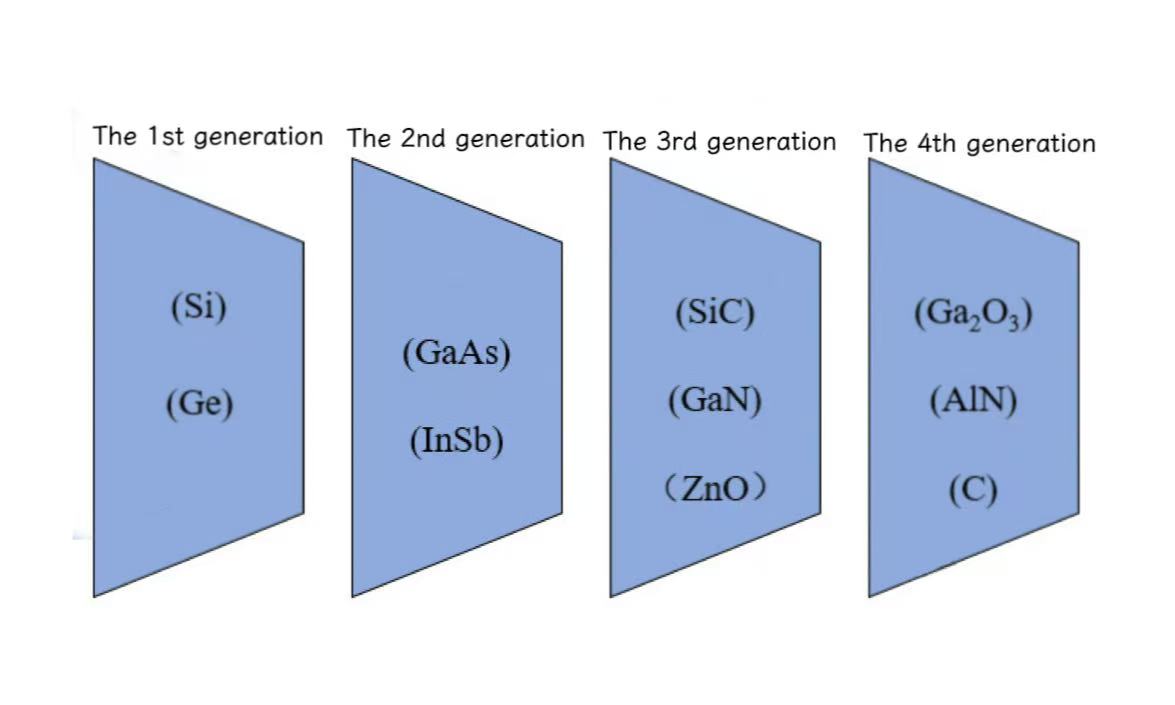
In the mid-20th century, the first generation of semiconductor materials were mainly composed of germanium (Ge) and silicon (Si). Notably, the first transistor and the first integrated circuit in the world were both made of germanium. But it gradually replaced by silicon in the late 1960s, because of its drawbacks such as low thermal conductivity, low melting point, poor high-temperature resistance, unstable water-soluble oxide structure, and week mechanical strength. Thanks to its superior high-temperature resistance, excellent radiation resistance, remarkable cost-effectiveness, and abundant reserves, silicon gradually replaced germanium as the mainstream material and maintained this position to date.
In the 1990s, the second generation of semiconductor materials began to emerge, with gallium arsenide (GaAs) and indium phosphide (InP) as representative materials. The second semiconductor materials offer advantages such as a large bandgap, low carrier concentration, superior optoelectronic properties, as well as excellent thermal resistance and radiation resistance. These advantages make them widely used in microwave communication, satellite communication, optical communication, optoelectronic devices, and satellite navigation. However, the applications of compound semiconductor materials are limited by issues such as rare reserves, high material costs, inherent toxicity, deep-level defects and difficulty in fabricating large-size wafers.
In the 21st century, third-generation semiconductor materials like silicon carbide (SiC), gallium nitride (GaN), and zinc oxide (ZnO) came into being. Known as wide-bandgap semiconductor materials, third-generation semiconductor materials exhibit excellent properties such as high breakdown voltage, high electron saturation velocity, exceptional thermal conductivity, and superb radiation resistance. These materials are suitable for the manufacturing of semiconductor devices that function in high-temperature, high-voltage, high-frequency, high-radiation and high-power applications.
Nowadays, the fourth-generation semiconductor materials are represented by gallium oxide (Ga₂O₃), diamond (C) and aluminum nitride (AlN). These materials are called ultra-wide bandgap semiconductor materials, having a higher breakdown field strength than third-generation semiconductors. They can withstand higher voltages and power levels, suitable for manufacturing high-power electronic devices and high-performance radio frequency electronic devices. However, the manufacturing and supply chain of these fourth-generation semiconductor materials are not mature, posing significant challenges in production and preparation.